Among the countless treasures of the Louvre, few sculptures capture emotion and movement as beautifully as Antonio Canova’s Psyche Revived by Cupid’s Kiss. Created at the height of the Neoclassical period, this marble masterpiece immortalizes one of the most touching love stories from classical mythology. More than two centuries after its creation, Canova’s masterpiece remains one of the finest examples of Neoclassical sculpture ever produced.
Table of Contents
An Epic Love Story - What Is Psyche Revived by Cupid’s Kiss?
Created by the Italian sculptor Antonio Canova between 1787 and 1793, this marble masterpiece captures one of the most moving moments in classical mythology: the instant Cupid awakens Psyche from a death-like sleep with a kiss. Antonio Canova, often regarded as the greatest sculptor of the Neoclassical era, sought to revive the artistic ideals of Ancient Greece and Rome while infusing them with a sensitivity that was distinctly modern. In Psyche Revived by Cupid’s Kiss, he achieved a remarkable balance between classical perfection and human emotion.
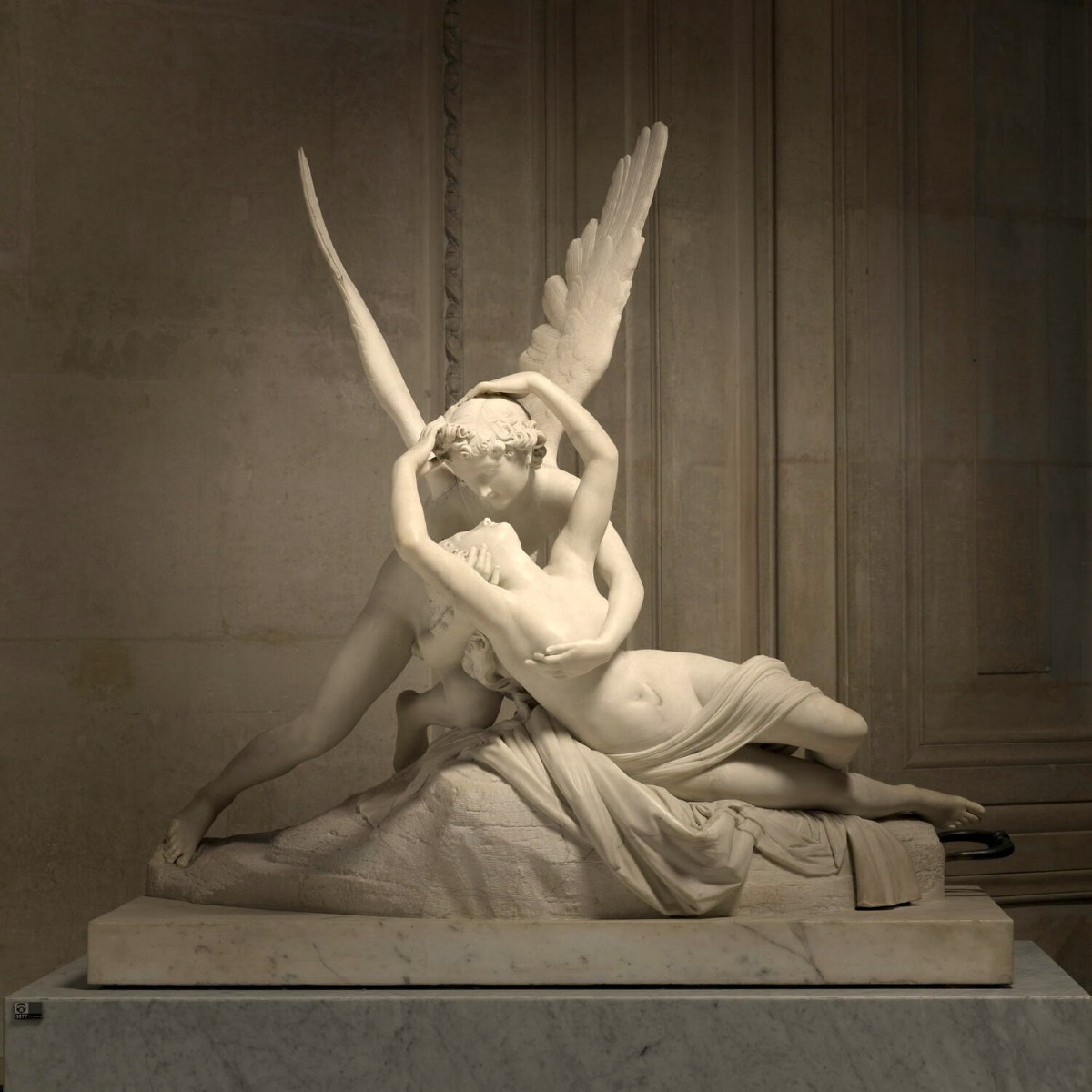
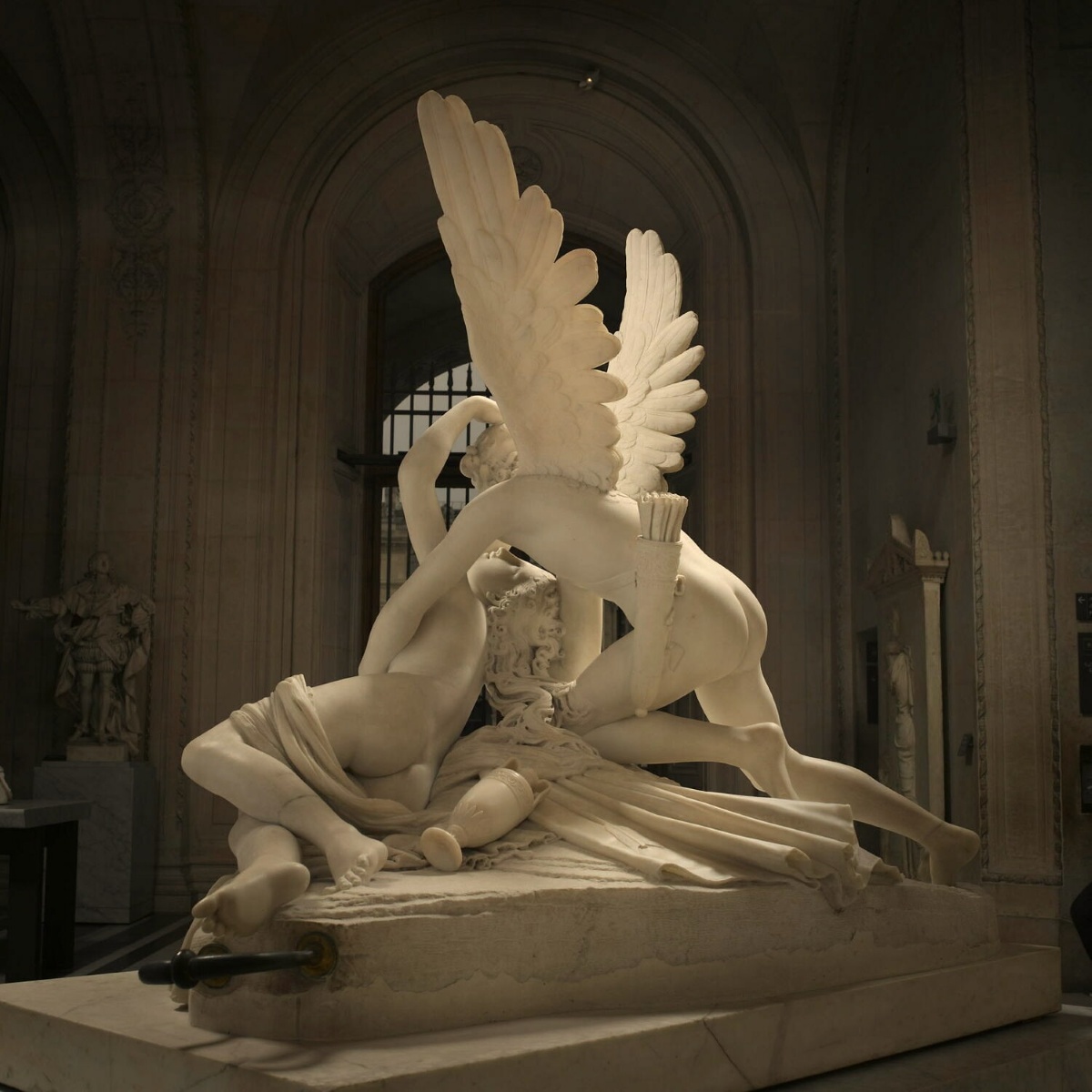
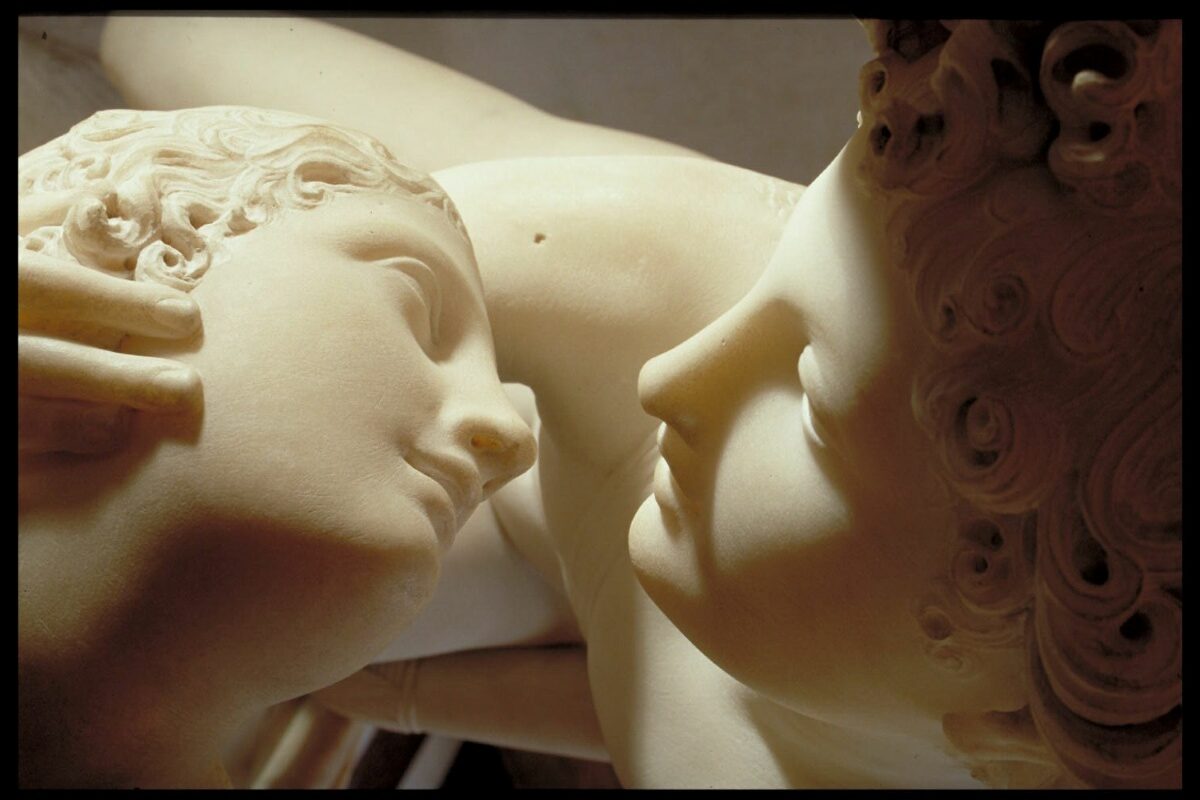
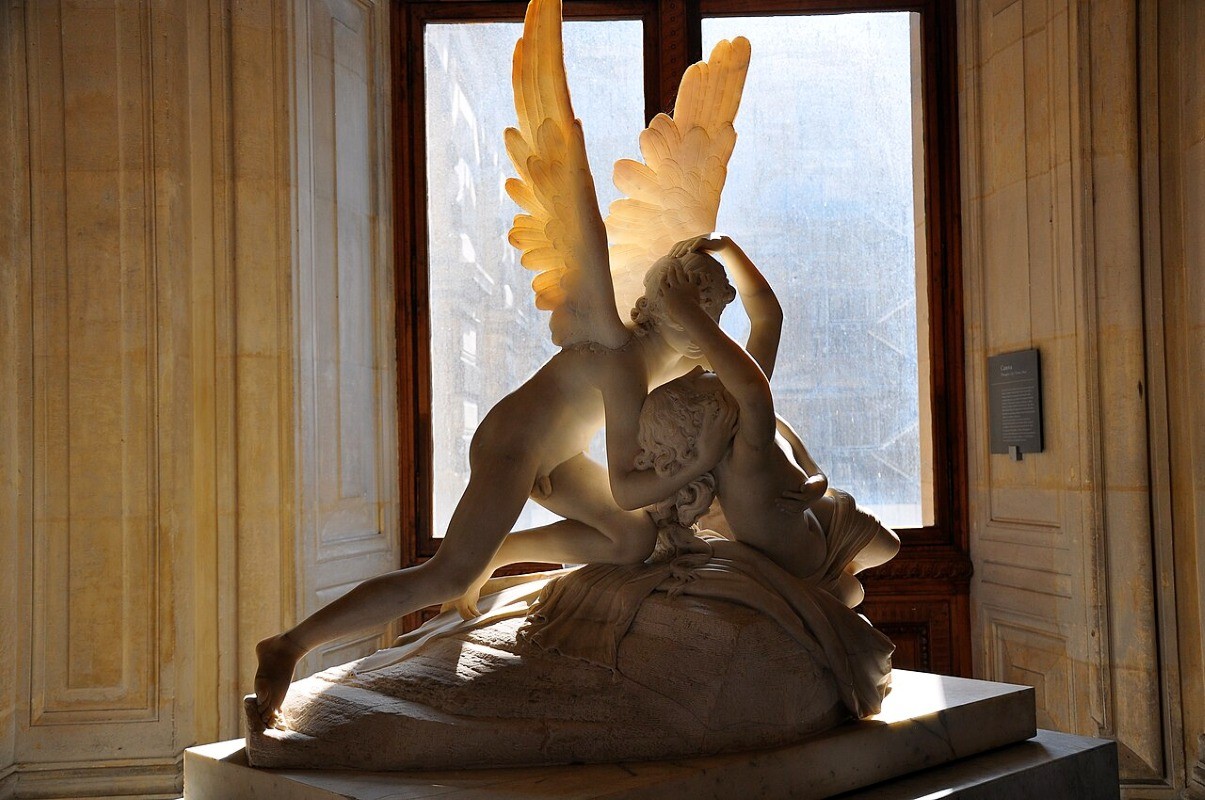
Carved from marble, the sculpture depicts two intertwined figures: Cupid, the god of love, bending gently over Psyche, his mortal lover, as she awakens in his arms. The composition is astonishingly dynamic. The lovers’ bodies form an elegant pyramid base and their curves that draw the eye toward the focal point, their faces in the brief moment before a kiss.
One of the most extraordinary aspects of the sculpture is Canova’s ability to transform stone into something seemingly alive. The softness of Psyche’s skin, the delicate feathers of Cupid’s wings, and the tenderness of their embrace all appear almost impossible for marble to convey. It is precisely this illusion that made Canova famous throughout Europe during his time.
But who was Antonio Canova?
Antonio Canova (1757–1822) was the most celebrated sculptor of the Neoclassical period and one of the most influential artists in European history. Born in the small town of Possagno, in the Venetian Republic, he demonstrated exceptional talent from a young age and quickly gained recognition for his ability after setting up his workshop in Rome. His works are characterized by their harmonious proportions, refined surfaces, and remarkable ability to convey emotion through marble.
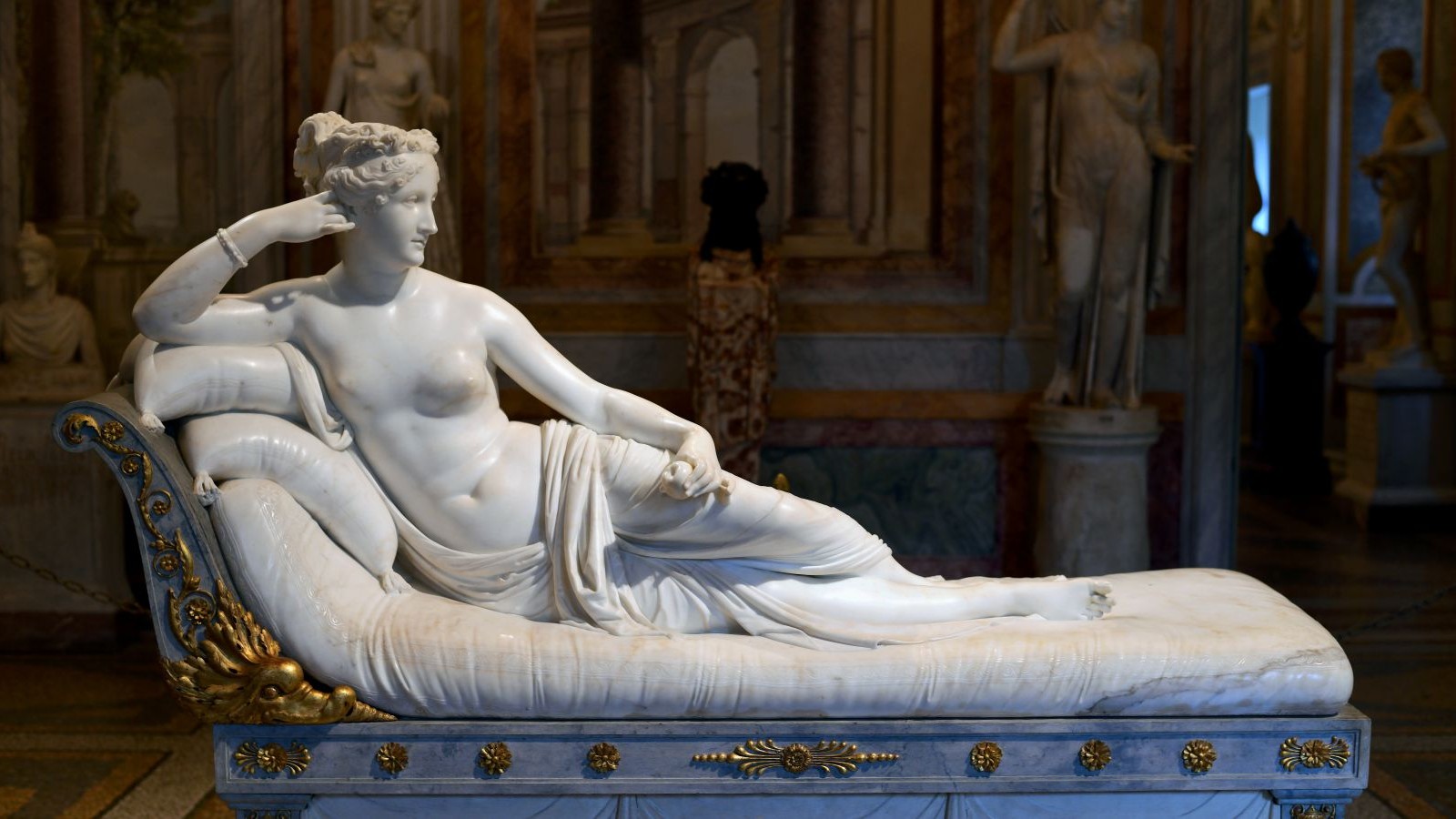
Canova attracted patrons from across Europe, including popes, emperors, and aristocrats. He became famous for transforming hard stone into figures that appear soft, graceful, and alive. Among his most renowned works are Psyche Revived by Cupid’s Kiss, The Three Graces, and Pauline Bonaparte as Venus Victrix. Today, he is widely regarded as the master of Neoclassical sculpture, and his works continue to inspire artists and captivate museum visitors around the world. His contemporary Jacques Louis David also painted for the Napoleon’s Dynasty, such as the Coronation of Napoleon.
The Incredible Technique of Canova on Psyche Revived by Cupid's Kiss
One of the reasons Psyche Revived by Cupid’s Kiss is considered a masterpiece is Canova’s extraordinary ability to vary his carving techniques across different parts of the sculpture. Rather than treating the marble as a uniform surface, he adapted his tools and finishing methods to create distinct textures that imitate the qualities of skin, feathers, and fabric.
The bodies of Cupid and Psyche are polished to an exceptional smoothness, giving their skin a luminous, soft appearance. Canova spent countless hours refining these surfaces, using abrasives and polishing compounds to soften the marble and create subtle transitions between muscles, limbs, and facial features. The result is a remarkable sense of warmth and tenderness that seems impossible to achieve in stone.
By contrast, Cupid’s wings are treated with much greater texture and detail. Individual feathers are carefully carved and layered, creating depth and lightness. The crisp edges catch the light differently from the polished skin, helping the wings appear delicate and weightless despite being carved from the same block of marble. These efforts allow the wings to appear translucent in the sunlight.
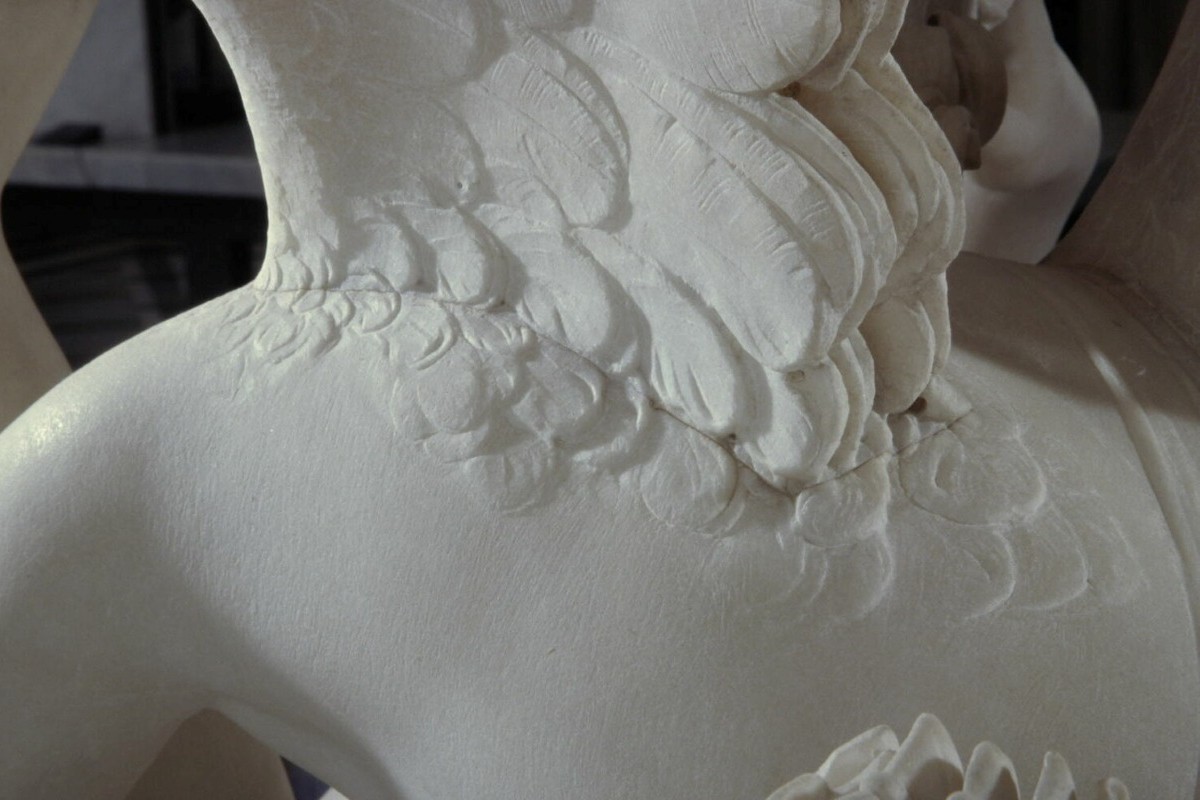
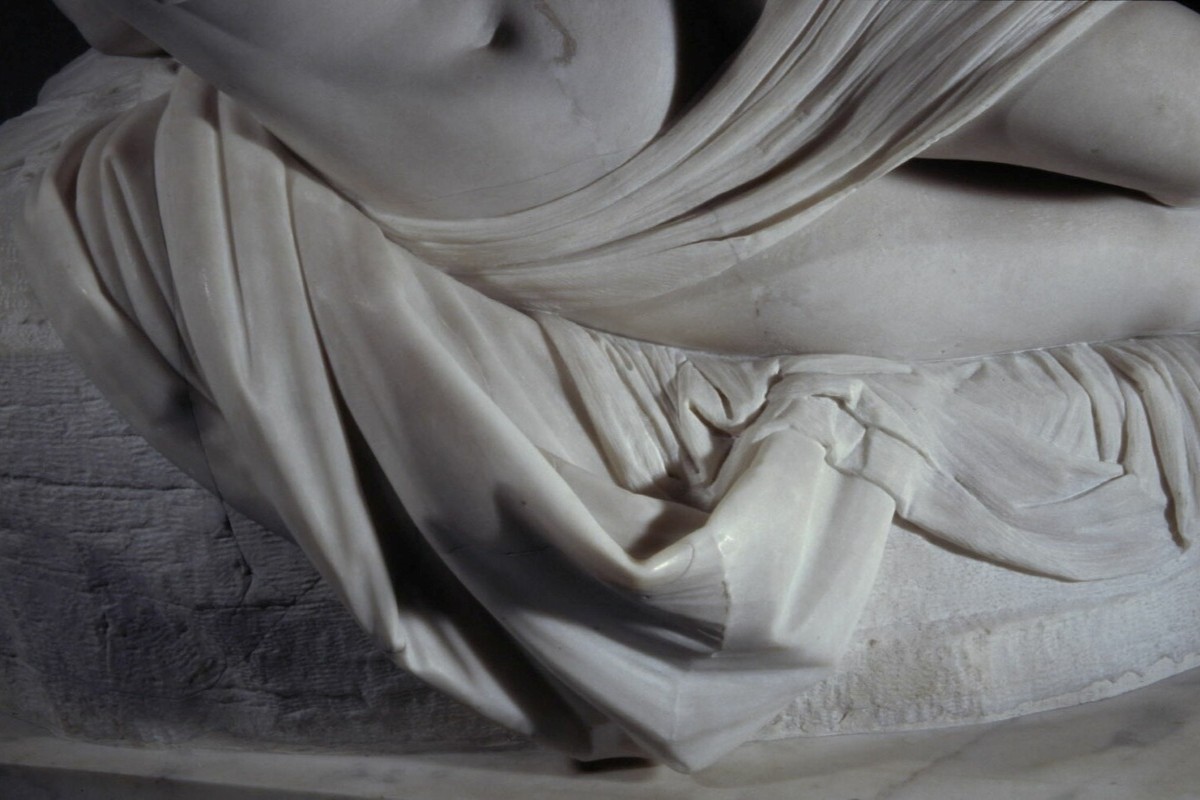
Canova also distinguished the drapery through a separate approach. The cloth beneath the figures features sharper folds and deeper cuts, producing stronger shadows and a sense of movement. These more angular surfaces contrast beautifully with the softness of the bodies, emphasizing the realism of the scene and guiding the viewer’s eye through the composition.
Through these subtle variations in texture and finish, Canova transformed marble into a convincing illusion of flesh, feathers, and fabric, demonstrating the technical brilliance that made him the leading sculptor of the Neoclassical age. This makes the sculpture fascinating to compare with classical works such as Venus de Milo, or even the Winged Victory of Samothrace.
The Myth of Cupid and Psyche Behind the Sculpture
The tale of Cupid and Psyche is first recorded in Apuleius’ Metamorphoses, a Roman novel written during the second century AD. Psyche was a mortal princess of such extraordinary beauty that she attracted a cult following, which admired her instead of Venus, goddess of beauty and love. Consumed by jealousy, Venus ordered her son Cupid to make the young woman fall in love with the most hideous creature.
While on the way to complete his mission, Cupid accidentally wounded himself with one of his own arrows and became deeply enamored of Psyche. The two began a secret romance, with one rule. Psyche could never look upon Cupid’s face so his identity would remain a secret.
Eventually, persuaded by her sisters, Psyche broke her promise, holding a lantern above his sleeping face. When Cupid awoke and discovered the betrayal, he disappeared. Determined to win him back, Psyche undertook a series of nearly impossible trials imposed by Venus. Her final task led her to the Underworld, where she received a mysterious box said to contain divine beauty.
Unable to resist curiosity, Psyche opened the box and immediately fell into a deep enchanted sleep. Seeing her lifeless body, Cupid rushed to her side and awakened her with a kiss.
This is the exact moment Canova chose to immortalize. It is a scene not of triumph or action, but of tenderness, forgiveness, and love.
A Connection to the Sun King - Psyche and Cupid at Versailles
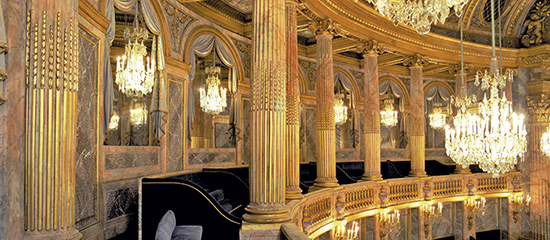
Interestingly, the story of Cupid and Psyche was also well known at the court of Louis XIV, where classical mythology played a central role in royal art, architecture, theater, and court festivities. The Sun King often used mythological themes to celebrate his reign and to associate himself with the gods and heroes of antiquity, which can be best seen in the Hall of Mirrors.
The tale of Psyche was particularly popular as love was a major theme of court life. In 1671, Louis XIV’s playwright Jean-Baptiste Molière collaborated with other playwrights and the composer Jean-Baptiste Lully on Psyché, a retelling of the myth as described above. It was a magnificent court spectacle that combined theater, music, dance, and elaborate stage effects. The production was one of the most ambitious entertainments ever staged for the French court and performed 82 times during Molière’s lifetime.
The enduring popularity of the myth of Cupid and Psyche at Versailles elevates why Canova’s sculpture continues to resonate today. it represents not only one of antiquity’s greatest love stories but also a theme that occupied a special place in the cultural world of the Sun King.
Cupid and Psyche’s Journey to the Louvre
How Did the Sculpture Reach the Louvre?
The sculpture was commissioned in 1787 by British politician and avid collector, Colonel John Campbell, during his visit to Rome. In this period, wealthy European aristocrats traveled across Italy in search of art inspired by classical antiquity, and Canova had quickly become one of the continent’s most sought-after artists.
However, before reaching its owner, the work attracted the attention of Joachim Murat, Napoleon Bonaparte’s brother-in-law and future King of Naples. The sculpture entered his prestigious collection and remained associated with some of the most influential figures of the Napoleonic era, including Napoleon himself who moved the sculpture to the royal residence of Compiègne.
Following the various political changes of the early nineteenth century, the masterpiece entered the French national collections. In 1822, the same year of Canova’s death, the sculpture arrived back at the Louvre, where it has remained ever since.
The Second Version at the Louvre-Lens
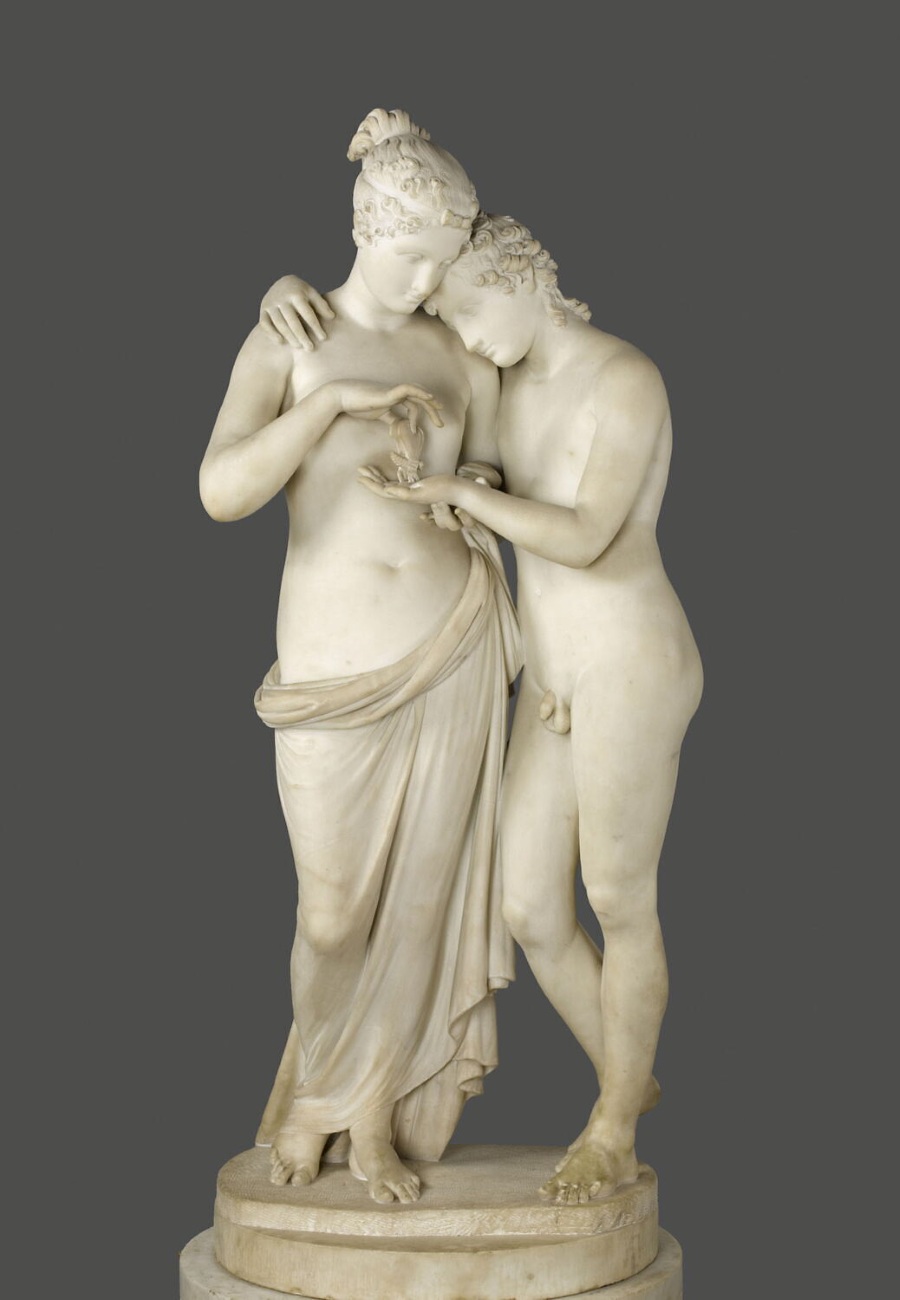
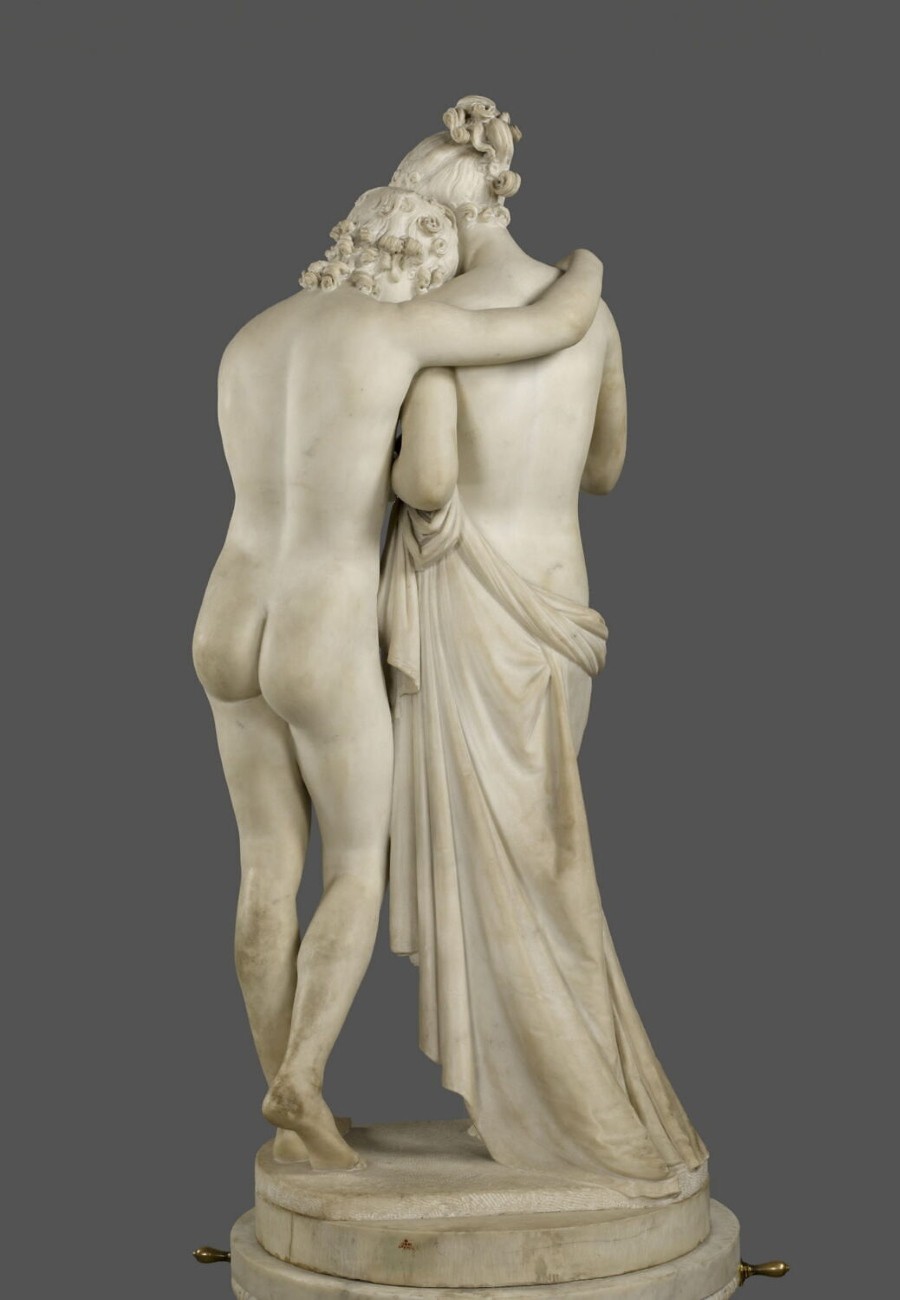
The sculpture displayed in the Louvre is not the only version of Psyche Revived by Cupid’s Kiss created by Antonio Canova. The sculptor produced a second marble version, also at the beheast of John Campell, between 1796 and 1800. Although the two sculptures depict the same myth, they are quite different in composition. The second version, often known as Cupid and Psyche Standing, presents the couple upright in a more formal embrace. Rather than emphasizing the instant of revival, it focuses on the tenderness and harmony of their relationship. Psyche offers her lover a butterfly, which was believed to represent the soul. In fact, the insect was called psyche in ancient Greek!
The second version followed the same journey as the first, but is now displayed at the Louvre-Lens, the Louvre’s satellite museum in northern France. Located in the Galerie du Temps, it allows visitors outside Paris to experience one of Canova’s most celebrated creations in a setting designed to highlight masterpieces from different periods of art history.
Together, the two works reveal how Canova could interpret the same myth in distinct ways, exploring both movement and emotion while pursuing his ideal of beauty.
Where to Find Psyche Revived by Cupid’s Kiss in the Louvre
Visitors can admire this beautiful sculpture in the Denon Wing, Ground Floor, Room 403 (Galerie Michel-Ange or Gallery Michael Angelo), which is dedicated to Italian sculpture.
Our advice is simple and the same for many of the Louvre’s masterpieces: take your time! Stand directly in front of the sculpture, then slowly circle around it. Unlike many sculptures that have a single best viewpoint, this masterpiece was designed to be experienced from every angle. In fact, on the original base of the piece, Canova built a turntable! You can still see the handle today. As you walk around the sculpture, new details emerge at every angle.
Some visitors believe the best time to visit is in the late afternoon when rays of light shine through Cupid’s gentle wings. Others prefer to explore the Louvre Museum at night, as it is usually less crowded.
FAQs about Psyche Revived by Cupid's Kiss
Psyche Revived by Cupid’s Kiss is displayed in the Denon Wing of the Louvre Museum, on the Ground Floor in Room 403 (Galerie Michel-Ange). It is one of the Louvre’s most admired sculptures and a highlight of the Italian sculpture collection.
Many art historians regard Psyche Revived by Cupid’s Kiss as Antonio Canova’s greatest work because it perfectly combines emotion, movement, and technical brilliance. The sculpture is often cited as one of the finest achievements of Neoclassical sculpture.
Yes. The myth of Cupid and Psyche was extremely popular at the court of Louis XIV. In 1671, Molière and Lully adapted the story into the spectacular court production Psyché, which became one of the most celebrated entertainments of the Sun King’s reign.
Yes. In addition to the famous version at the Louvre Museum, Antonio Canova created another sculpture inspired by Cupid and Psyche, known as Cupid and Psyche Standing. It is now displayed at Louvre-Lens, the Louvre’s satellite museum in northern France.
Experience a Love Story as old as time during your visit to the Louvre
Standing before Psyche Revived by Cupid’s Kiss, it is easy to admire Canova’s technical brilliance. Yet the true magic of this masterpiece lies in the story behind the marble, the ancient myth, the symbolism, and the extraordinary journey that brought it to the Louvre.
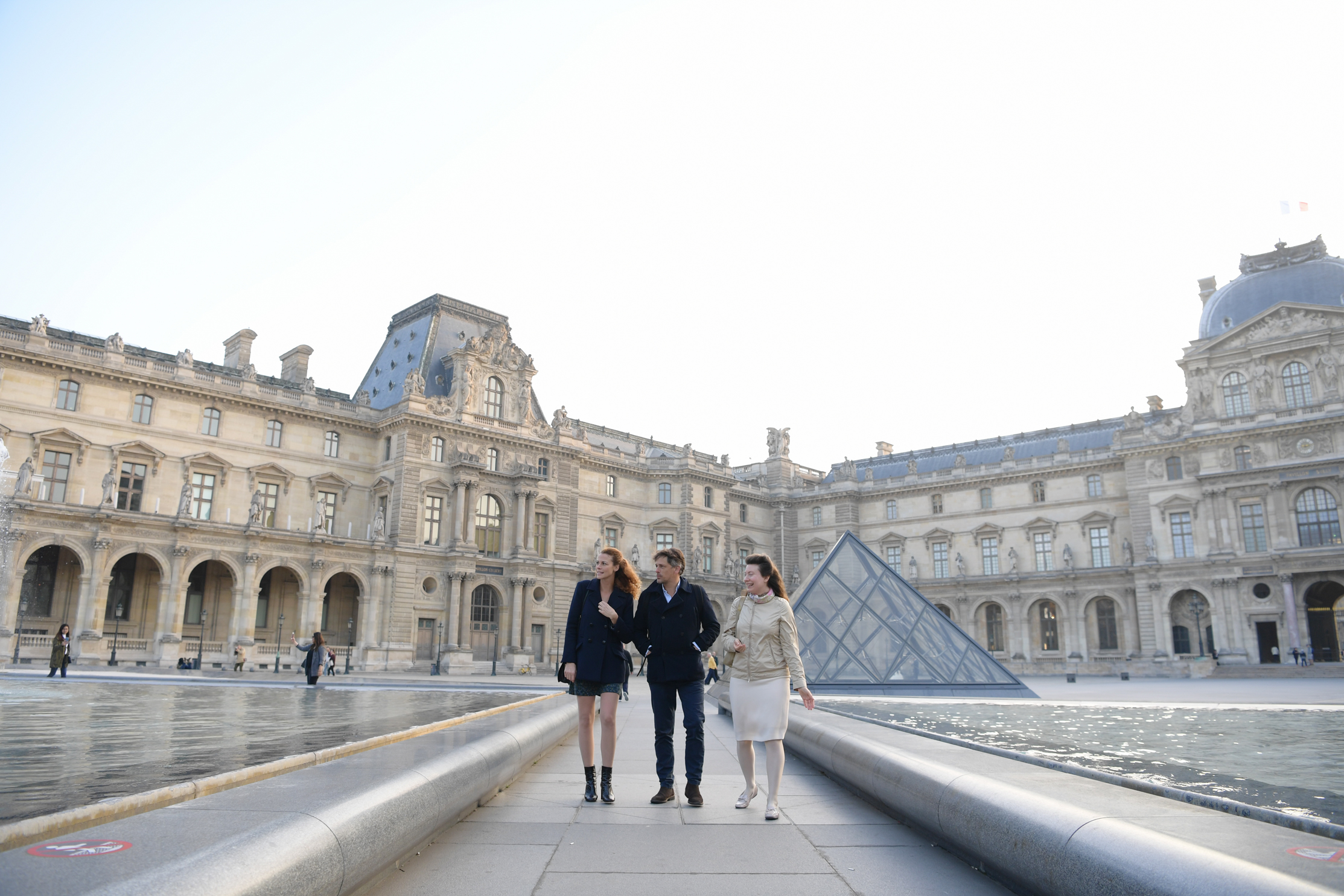
During a private Louvre tour, our expert guides reveal the fascinating stories hidden behind the museum’s most celebrated works, helping you see far more than what appears at first glance. From the timeless romance of Cupid and Psyche to the secrets of the Mona Lisa and the Winged Victory of Samothrace, every masterpiece becomes part of a richer journey through art and history.
Louvre Through the Ages
Learn more about the fascinating history and lavish royal lives with your expert guide!