
The Venus de Milo is one of the Louvre Museum’s greatest icons, admired by millions of visitors each year for her elegant posture, idealized beauty, and legendary missing arms. Created in ancient Greece and discovered on the island of Milos in 1820, the statue has become a symbol of classical art, feminine grace, and artistic mystery.
For cultivated travelers visiting Paris, the Venus de Milo offers far more than a famous photo opportunity. She is a lesson in beauty, history, restoration, and the irresistible human habit of imagining what history has chosen not to reveal.
Is she Aphrodite, goddess of love? Is she Amphitrite, a sea goddess worshipped on Milos? What was she holding? Why were her arms never restored? And how did an incomplete statue become one of the most recognized images of beauty in Western art?
Finding answers to these questions is precisely why the Venus de Milo deserves time, context, and an excellent guide.
Table of Contents
A Masterpiece in Marble ~ What is the Venus de Milo?
The Venus de Milo is an ancient Greek marble statue, generally believed to represent Aphrodite, the Greek goddess of love and beauty, known to the Romans as Venus.
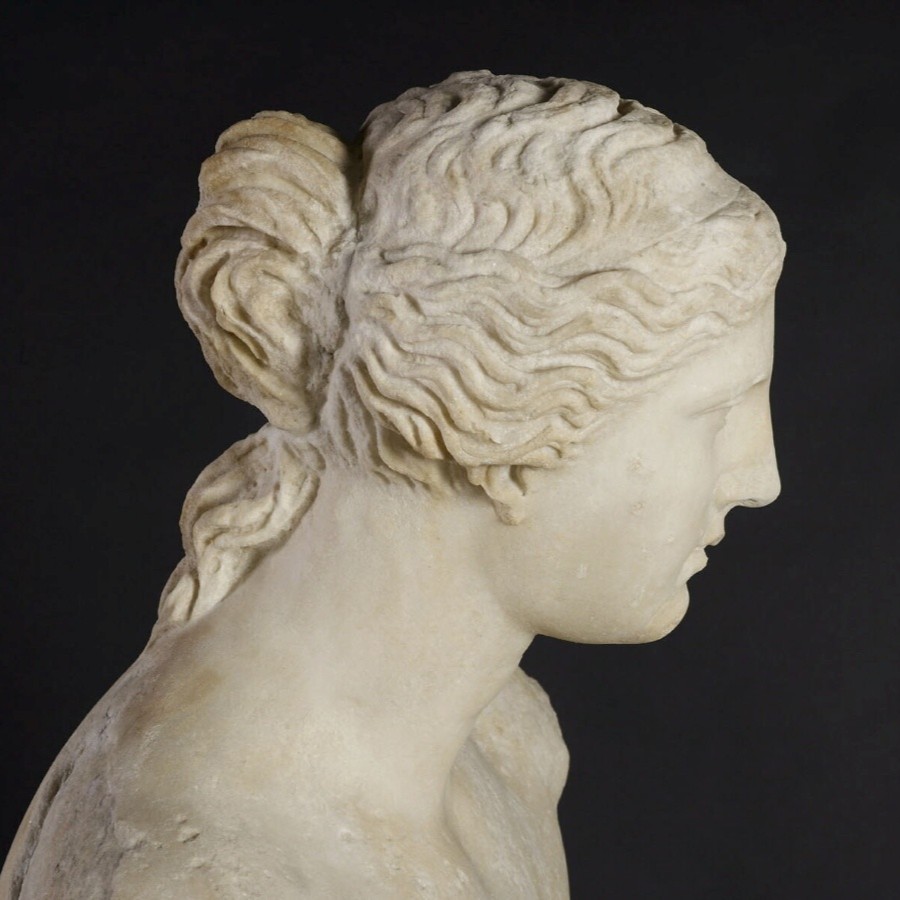
She was carved during the Hellenistic period, usually dated around the 2nd century BC. Unlike the more stagnant art of classical Greece, Hellenistic sculpture often embraced movement, drama, sensuality, and psychological depth. The Venus de Milo is a perfect example of this transition: she has the calm dignity of an ideal goddess, but also the subtle twist, exposed flesh, and quiet aura of a living presence.
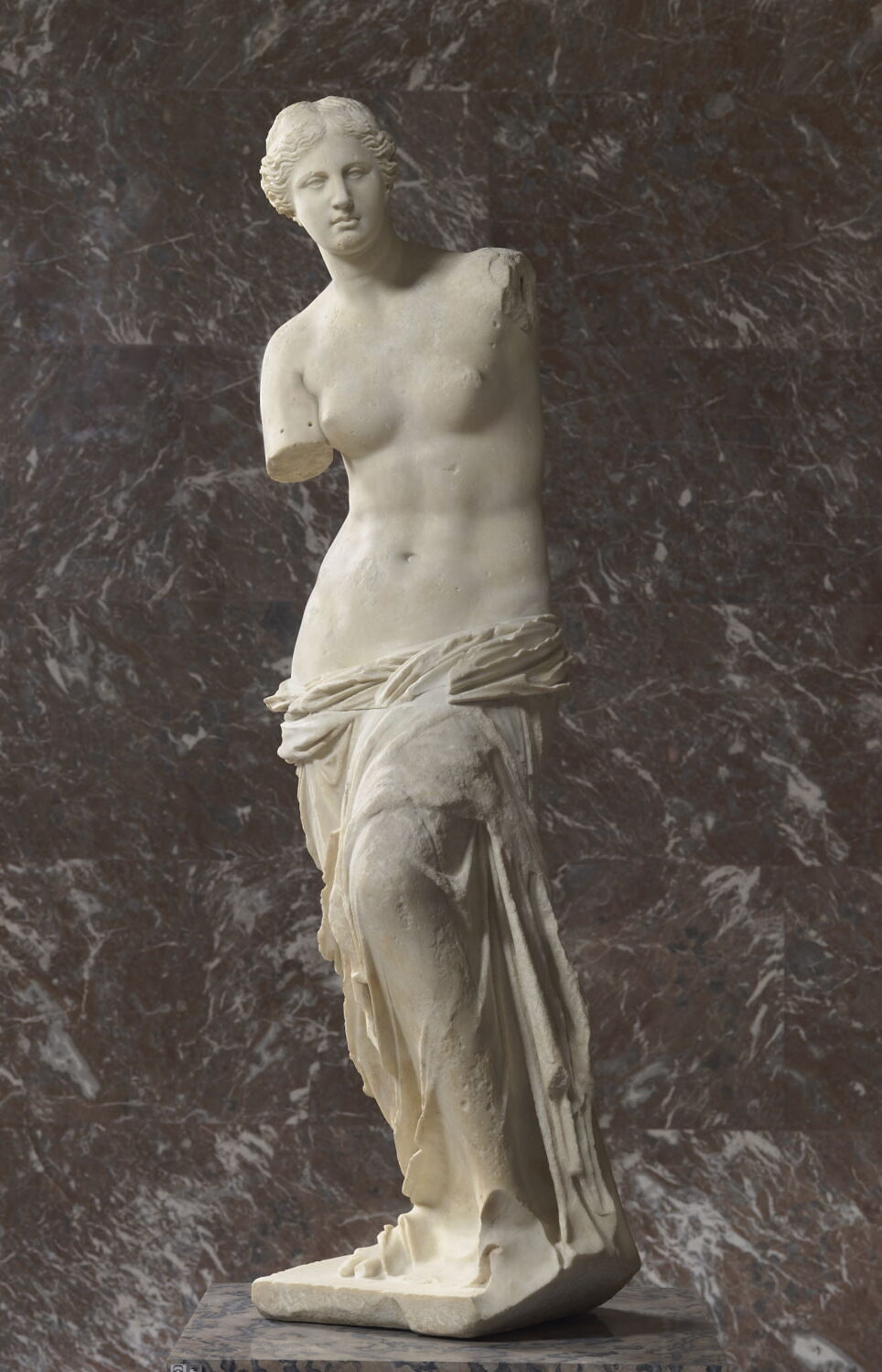
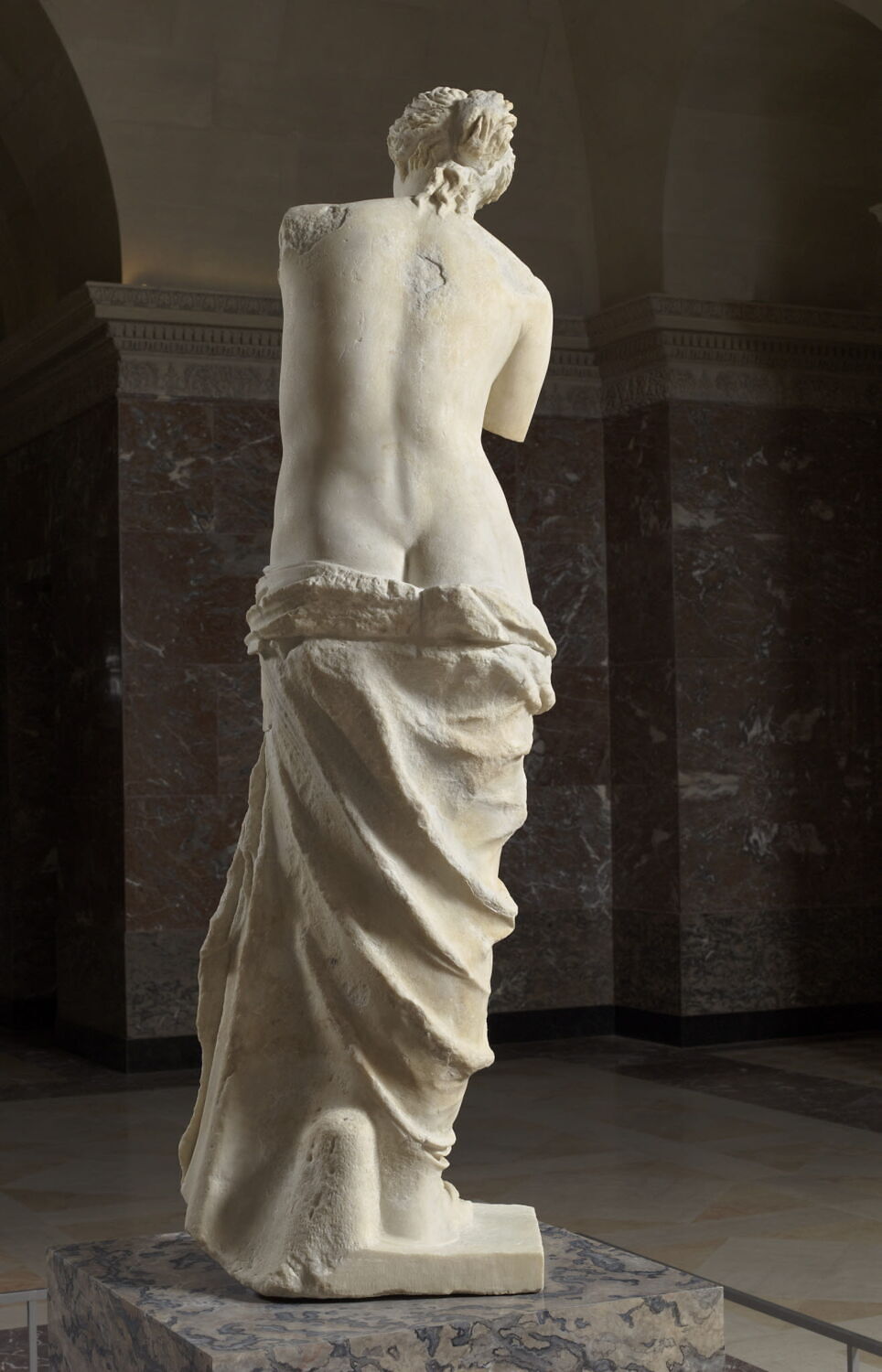
The statue is made of Parian marble, a highly prized white marble from the Greek island of Paros. She stands over two meters high, larger than life, with her upper body exposed and her lower body wrapped in a heavy drapery known as a himation.
The drapery seems almost about to slip, yet nothing feels vulgar. Her torso turns gently, her head remains composed, and her missing arms invite your imagination to complete what the marble refuses to explain.
Her beauty lies in contrast between stillness vs. movement and modesty vs. sensuality.
Why “Venus” and why “Milo”?
The name Venus de Milo simply means “Venus of Milos.” Milos is the Greek island in the Aegean Sea where the statue was discovered. “Venus” is the Roman name for Aphrodite, although scholars still debate whether the statue truly represents Aphrodite or another goddess.
This uncertainty is part of her charm. The Venus de Milo is famous not because everything is known about her, but because so much remains open.
History of Venus de Milo
The history of the Venus de Milo begins not in the royal palace of Versailles or a grand excavation site, but on a humble farm of a Greek island.
The discovery on Milos in 1820
In 1820, the statue was discovered on the island of Milos, which at that time was a part of the Ottoman Empire. The discovery is usually credited to a local Greek farmer, who found the sculpture in pieces near the ruins of an ancient city.


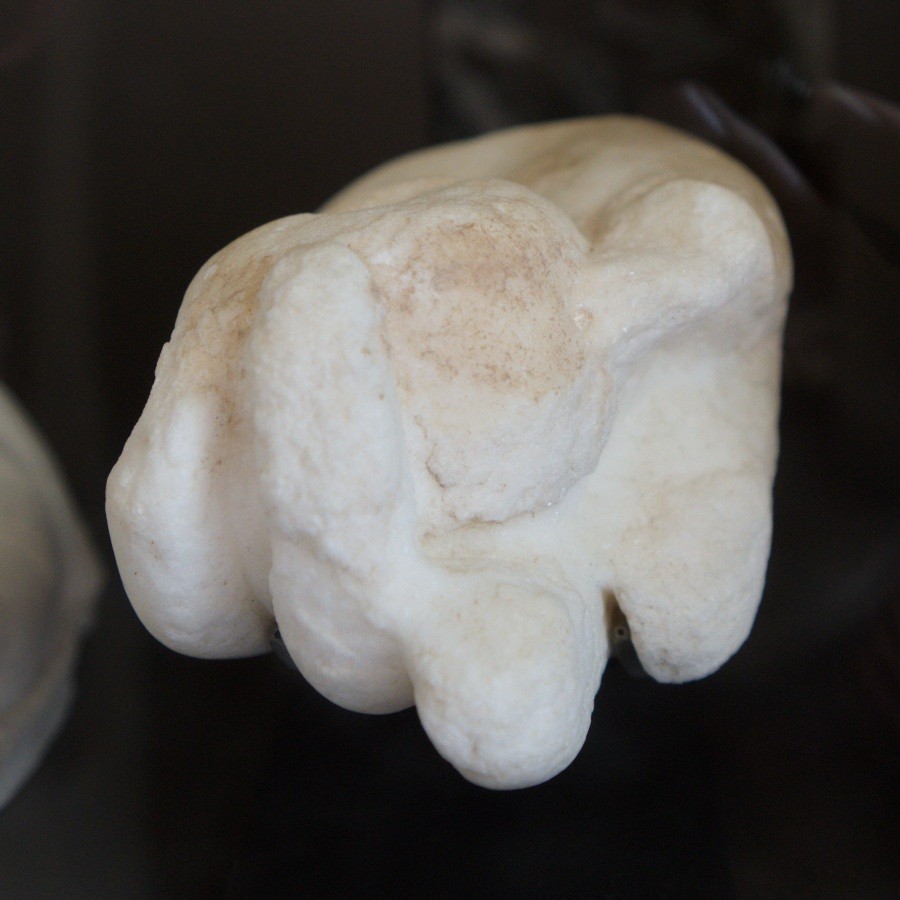
A French naval officer, Olivier Voutier, was stationed on the island and recognized the artistic importance of the find. Alongside the farmer, they found several pieces, including a hand holding an apple and two inscriptions that are now lost. Soon after, French diplomats became involved, and the statue was acquired for France.
Venus de Milo's Arrival at the Louvre and 19th century Conservation
The statue was presented to King Louis XVIII, who donated it to the Louvre in 1821. Its arrival came at a politically sensitive moment. France had recently returned many artworks taken during the Napoleonic era, although not all works were returned such as the Wedding at Cana by Veronese. The Louvre needed new symbols of prestige in its collection.
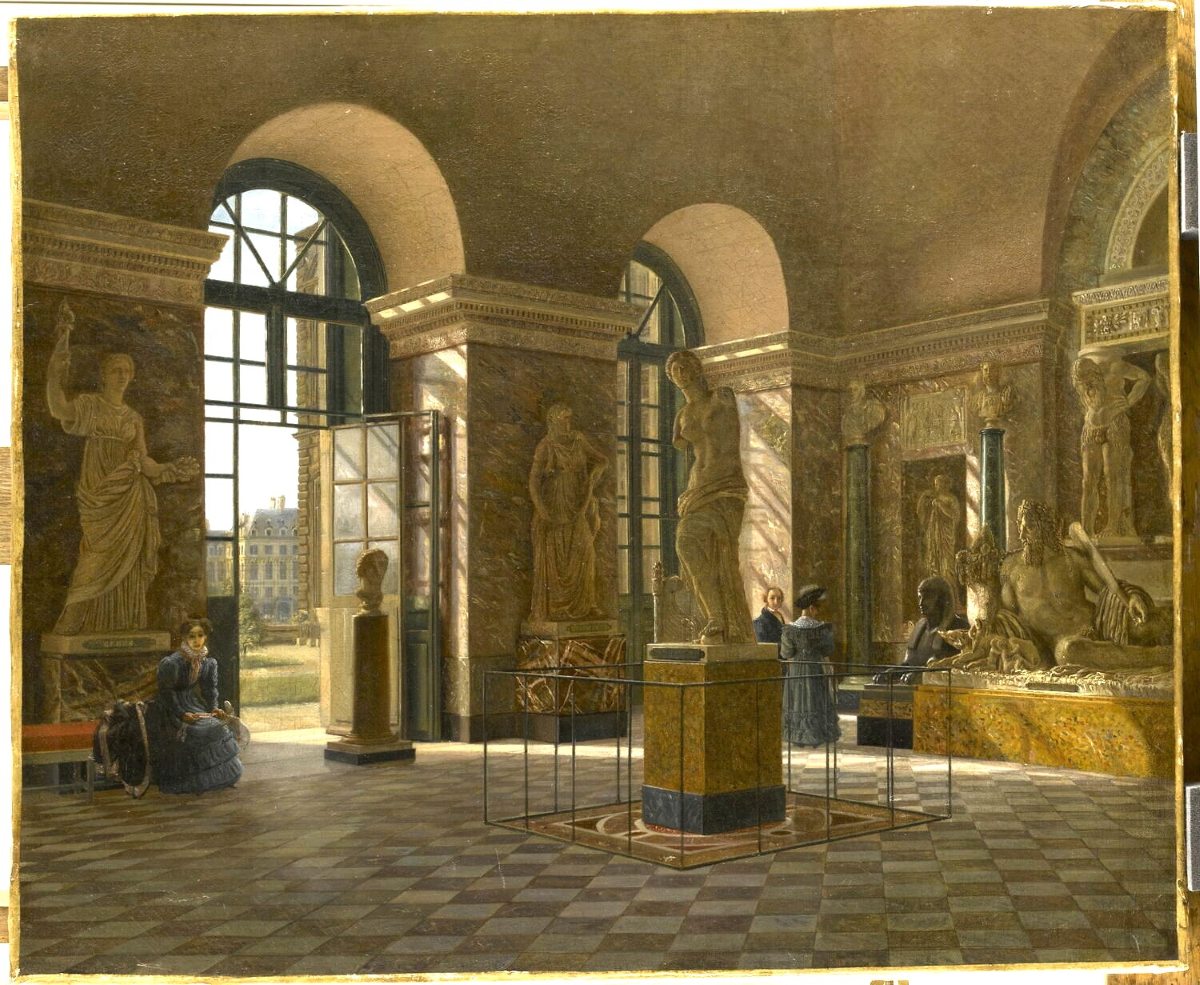
The Venus de Milo arrived at exactly the right time. She was ancient, beautiful, mysterious, and spectacularly incomplete.
In the 19th century, it was common to restore ancient sculptures, sometimes quite aggressively. Missing noses, fingers, limbs, and attributes were often recreated according to the taste of the period.
But with the Venus de Milo, the Louvre ultimately chose not to reconstruct the arms. A restored Venus might have become one more beautiful antique statue. Instead of weakening her impact, the missing arms made her unforgettable.
Secrets behind the Venus de Milo
The Venus de Milo is full of mystery because she is incomplete, but also because she stands at the crossroads of art, archaeology, politics, and desire. Let’s uncover some of her secrets together.
What happened to her arms?
This is the question every visitor asks.
The honest answer: we do not know with certainty.
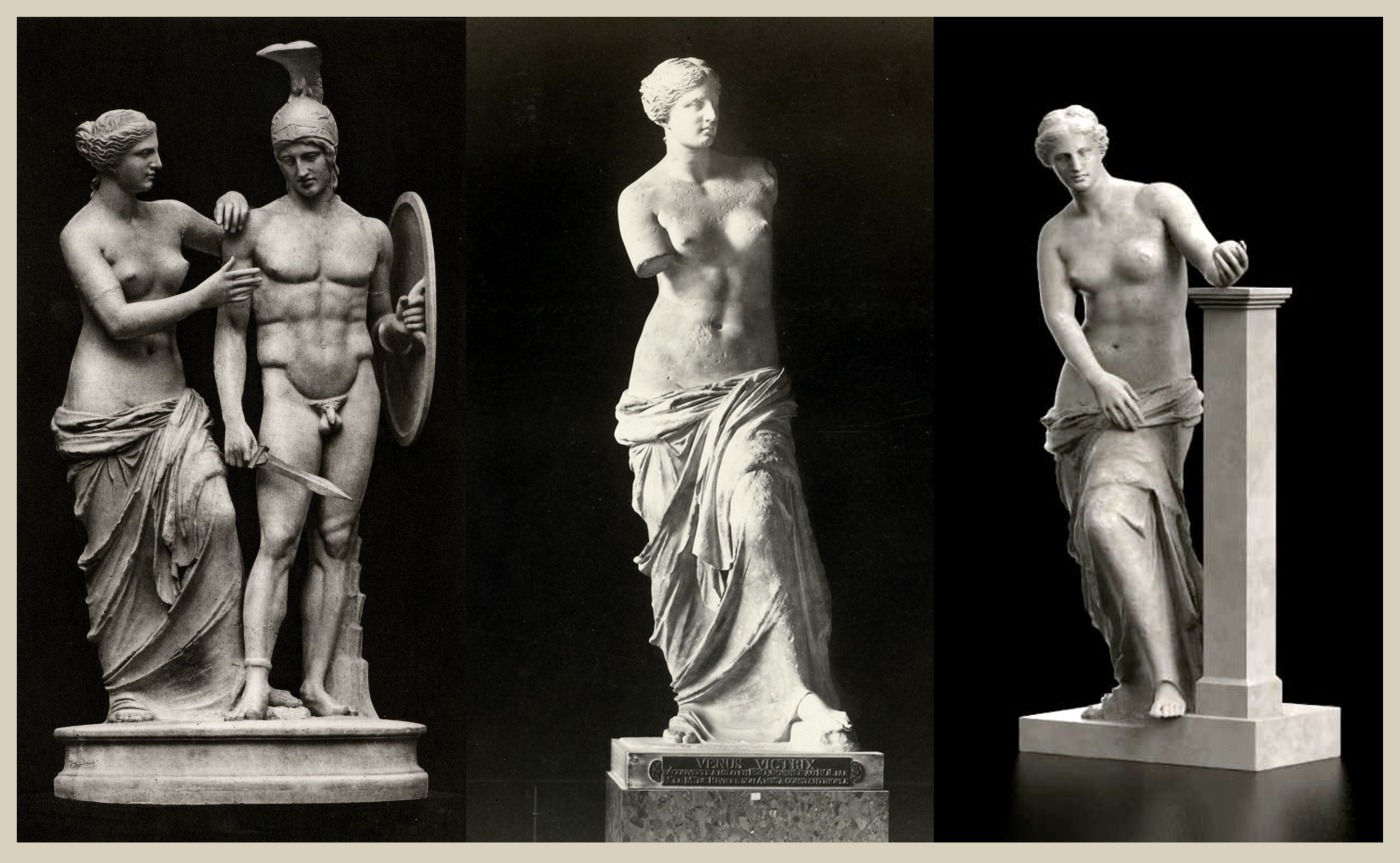
Several theories exist. While a hand holding an apple was reportedly found near the statue, the connection remains debated. If she held an apple, this could reference the myth of the Judgement of Paris, in which Aphrodite wins a golden apple after being chosen by Paris, the prince of Troy, as the most beautiful goddess.
Others suggest she may have held a mirror or a shield, which are also associated with the goddess of beauty, who is also the lover of Ares (Mars in Roman, the god of War).
Is Venus de Milo really Aphrodite?
Most art historians believe the Venus de Milo represents Aphrodite, the Greek goddess of love and beauty, mainly because of her sensual pose and the possibility that she once held an apple linked to Greek mythology. On the other hand, some scholars think she may represent Amphitrite, a sea goddess worshipped on the island of Milos where the statue was discovered. Since the arms are missing, her original attributes remain unknown and that mystery is part of what makes the sculpture so fascinating.
The Missing Inscription
One of the most intriguing mysteries concerns a now-lost inscription that may have named the sculptor as Alexandros of Antioch. If authentic, it would place the work firmly in the Hellenistic period.
The inscription disappeared, and with it some certainty of the statue’s origins.
This matters because early admirers wanted the statue to belong to the more prestigious classical age of Greek art, associated with other master sculptures like Praxiteles. A Hellenistic date made her slightly “later” than some critics wished. Yet today, that Hellenistic quality is precisely what makes her so compelling: the twist of the torso, the emotional ambiguity, the sensual realism beneath the divine calm.
Why is the Venus de Milo so famous?
The fame of the Venus de Milo comes from a rare combination of artistic quality, historical timing, museum prestige, and mystery.
She embodies an ideal of beauty
The statue has long been admired as an embodiment of classical beauty with its balanced proportions, smooth marble skin, a calm face, and a body that seems both idealized yet realistic.
Her beauty is not cold. The slight twist of the body gives her a quiet energy. The drapery around her hips creates tension. The exposed torso feels luminous, but never merely decorative.
These qualities made her a powerful source of inspiration for many 19th and 20th century French poets, writers, and artists and even today! The Venus de Milo came to symbolize not only ideal beauty, but also mystery, melancholy, and unattainable perfection. Her fragmented form fascinated Romantic, Symbolist, and Surrealist creatives in particular, who saw in her missing arms a poetic metaphor for lost civilizations, incomplete beauty, and the passage of time.
Even beauty labels such as L’Oreal use Venus de Milo as a model! Check out this campaign from 2025.
The Louvre made her a global icon
Once installed in the Louvre, the Venus de Milo became part of one of the world’s most powerful museum narratives. Reproductions, photographs, guidebooks, postcards, and later popular culture helped transform her into an instantly recognizable image.
The Louvre did not simply display her. It staged her. And staging matters. A masterpiece becomes legendary when a museum gives visitors the feeling that they are approaching something magnificent.
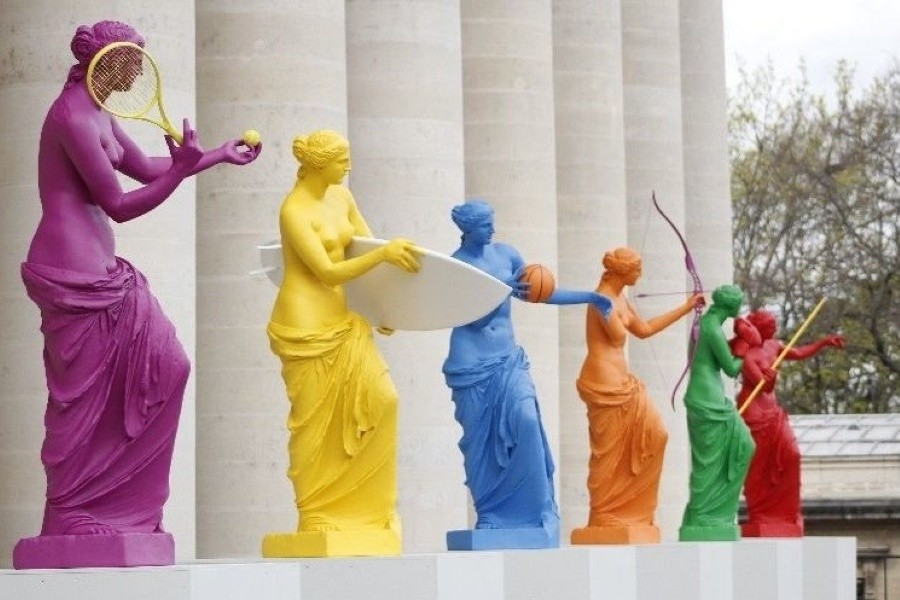
In addition, she has appeared countless times across popular culture, adding to her prestige.

Her mystery is easy to understand
Some works of art require specialist knowledge before they become interesting. The Venus de Milo does not.
Everyone immediately sees the mystery: where are her arms?
That simple question opens the door to archaeology, mythology, aesthetics, restoration ethics, and museum history. It is a perfect entry point for both first-time visitors and sophisticated art lovers.
Where to find Venus de Milo in the Louvre
You can find the Venus de Milo in the Department of Greek, Etruscan, and Roman Antiquities, in the Louvre Museum.
You can find the statue after entering the Sully Wing at Level 0 in Room 346. The room is called the Salle de la Vénus de Milo and there will be signs to follow.
For a more comfortable and potentially experience, we recommend visiting early in the morning or experiencing the Louvre Museum at Night. Either way, the Venus de Milo may be an excellent starting point for your route, especially for first time visitors.

This is one of the essential stops in the Louvre’s ancient sculpture galleries. Close by you will find another iconic sculpture, the Winged Victory of Samothrace.
FAQs about for the Venus de Milo
The Venus de Milo is located in the Sully Wing, Level 0, Room 345, also known as the Salle de la Vénus de Milo.
Her arms were already missing when the statue became known in the 19th century. Scholars still debate their original position and what she may have been holding. This mystery is one of the reasons the Venus de Milo is so famous.
The statue was discovered in 1820 on the Greek island of Milos and entered the Louvre’s collection shortly afterward.
The statue is generally dated to the Hellenistic period, around the 2nd century BC, making it more than 2,000 years old.
Have a Special Moment with an iconic Ancient Beauty at the Louvre!
The Venus de Milo is famous because she is beautiful, but she is unforgettable because she is incomplete. Her missing arms do not diminish her. They invite you closer.
In a museum filled with masterpieces, she offers something rare: a mystery that does not need to be solved in order to be enjoyed.
For travelers who want to experience the Louvre with intelligence, elegance, and comfort, the Venus de Milo is an ideal starting point. She teaches you how to look slowly, how to appreciate silence, and how a fragment of marble can become one of the most enduring images in the world.
To discover her with the depth she deserves, consider a private Louvre experience curated by Paris to Versailles Private Tours.
Louvre Through the Ages
Learn more about the fascinating history and lavish royal lives with your expert guide!