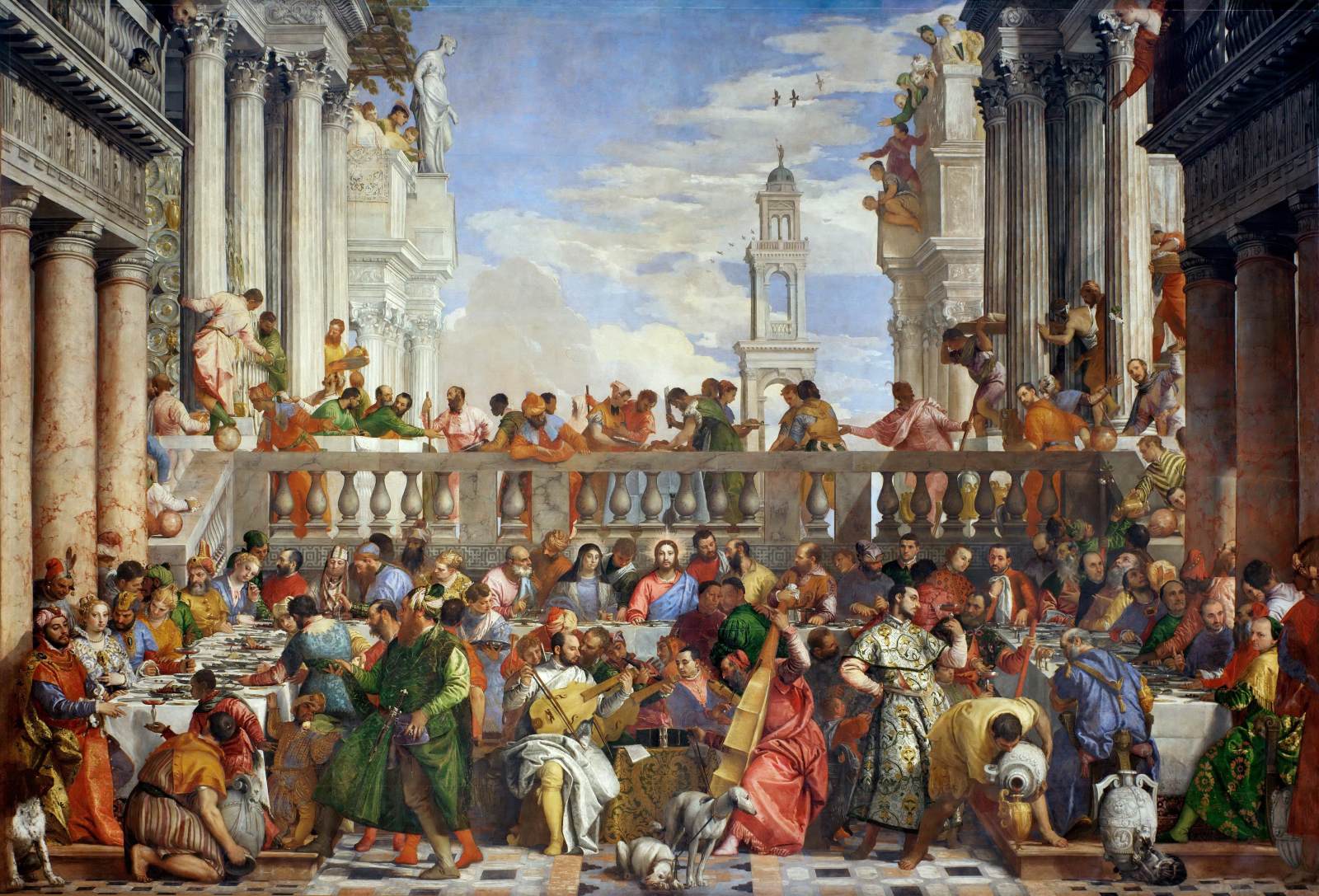
The Wedding at Cana by Paolo Veronese is the largest painting in the Louvre. Measuring 6.77 by 9.94 meters (22.2 by 32.6 feet), this monumental Renaissance masterpiece depicts Christ’s first miracle of turning water into wine during a wedding feast.
Painted in 1563 for the Benedictine monastery of San Giorgio Maggiore in Venice, the biblical scene is transformed into a spectacular Venetian banquet filled with more than 130 figures, musicians, servants, rulers and hidden symbols. Today, The Wedding at Cana hangs in Room 711 of the Louvre’s Denon Wing, directly opposite the Mona Lisa.
In this guide, discover the painting’s meaning, its most important figures and symbols, its extraordinary journey from Venice to Paris, and the details to look for when seeing it at the Louvre.
Table of Contents
- 1 What Is The Wedding at Cana by Paolo Veronese?
- 2 The Wedding at Cana: Size, Style and Composition
- 3 Who are the Figures in The Wedding at Cana?
- 4 Why Is The Wedding at Cana in the Louvre?
- 5 Where Is The Wedding at Cana in the Louvre?
- 6 Frequently Asked Questions About The Wedding at Cana by Veronese
- 7 Plan Your Visit to Step Inside this historical moment at the Louvre!
What Is The Wedding at Cana by Paolo Veronese?
Painted in 1563 by Renaissance artist Paolo Veronese, The Wedding at Cana , or the Wedding Feast at Cana, represents the biblical story in which Christ performs his first miracle, turning water into wine during a wedding feast in Cana.
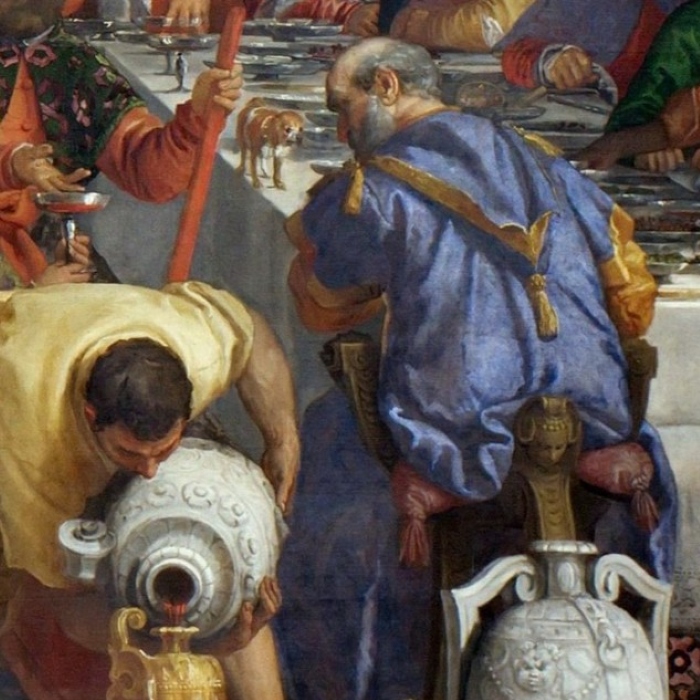
Instead of a modest biblical setting, Veronese stages the scene as a lavish Venetian banquet, filled with aristocrats, musicians, servants, and exotic details. This choice becomes even more meaningful when you recall the biblical episode itself (Gospel of John, 2:1–11): during a wedding feast, the wine runs out, which is an embarrassing and socially damaging situation for the hosts. At the request of his mother, Mary, Christ instructs servants to fill jars with water, which he then miraculously transforms into wine of exceptional quality. It is a discreet miracle, almost intimate, yet symbolically powerful: it reveals Christ’s divine nature while celebrating abundance, joy, and transformation.
| Key fact | Information |
|---|---|
| Artist | Paolo Veronese, also known as Paolo Caliari |
| Date | 1563 |
| Medium | Oil on canvas |
| Dimensions | 6.77 × 9.94 m / 22.2 × 32.6 ft |
| Number of figures | Approximately 130 |
| Original location | San Giorgio Maggiore, Venice |
| Current location | Room 711, Salle des États, Denon Wing, Louvre |
| Subject | Christ turning water into wine |
| Distinction | Largest painting in the Louvre |
By transposing this sacred moment into the world of 16th-century Venice, Veronese follows a widespread Renaissance practice. Artists of his time often painted biblical scenes as if they were unfolding in their own contemporary society. This allowed viewers to connect more directly with the story, recognizing familiar settings, fashions, and social rituals. In Venice, one of the wealthiest and most cosmopolitan cities of Europe at the time, this meant opulence, international guests, and refined spectacle.
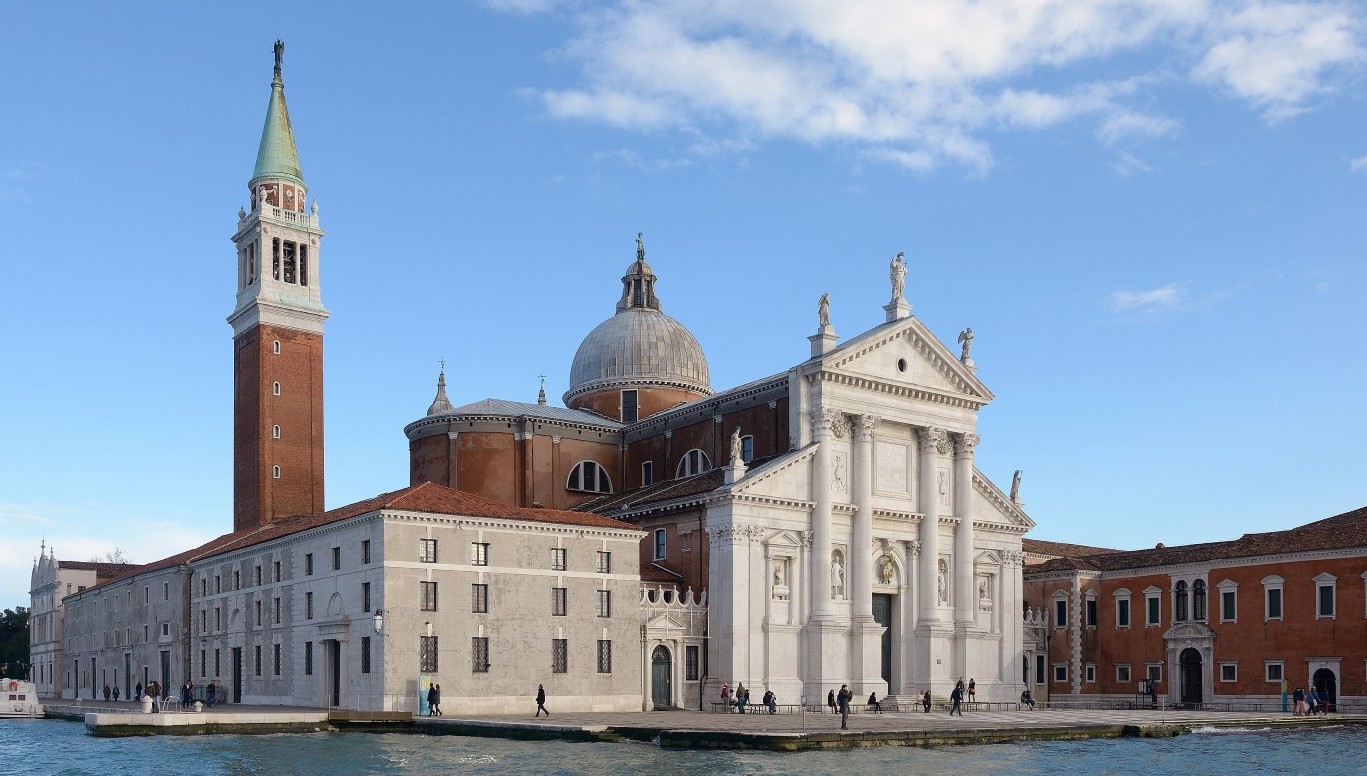
The painting thus becomes a reflection of Venetian grandeur at its peak, subtly merging sacred narrative with contemporary life. It is also important to understand why Veronese painted it this way: the work was commissioned for the refectory (dining hall) of the Benedictine monastery of San Giorgio Maggiore. Monks would eat their meals facing this immense canvas. By depicting a grand banquet, Veronese created a visual parallel between the monks’ daily meal and the biblical feast, elevating a simple act of dining into a spiritual and contemplative experience.
The Wedding at Cana: Size, Style and Composition
Measuring approximately 6.77 meters high by 9.94 meters wide (about 22.2 by 32.6 feet), The Wedding at Cana is regarded as the largest painting in the Louvre. It is even bigger than the Coronation of Napoleon by David. Its sheer scale was designed to immerse viewers completely, especially in its original monastic setting.
The painting is also a remarkable example of Mannerism, the artistic style that followed the High Renaissance. Unlike the perfect harmony and natural balance of artists like Leonardo or Raphael, Mannerism embraces complexity, elegance, and sometimes deliberate exaggeration. Figures may appear elongated, compositions more intricate, and perspectives slightly theatrical.
In Veronese’s hands, Mannerism becomes something uniquely Venetian: a celebration of grandeur, spectacle, and refined sophistication. The composition remains harmonious, yet it is enriched by a sense of abundance, layered narratives, and visual sophistication that invites prolonged contemplation. Its composition is a masterpiece of balance and rhythm that at first glance appears chaotic!
A Perfectly Balanced Wedding
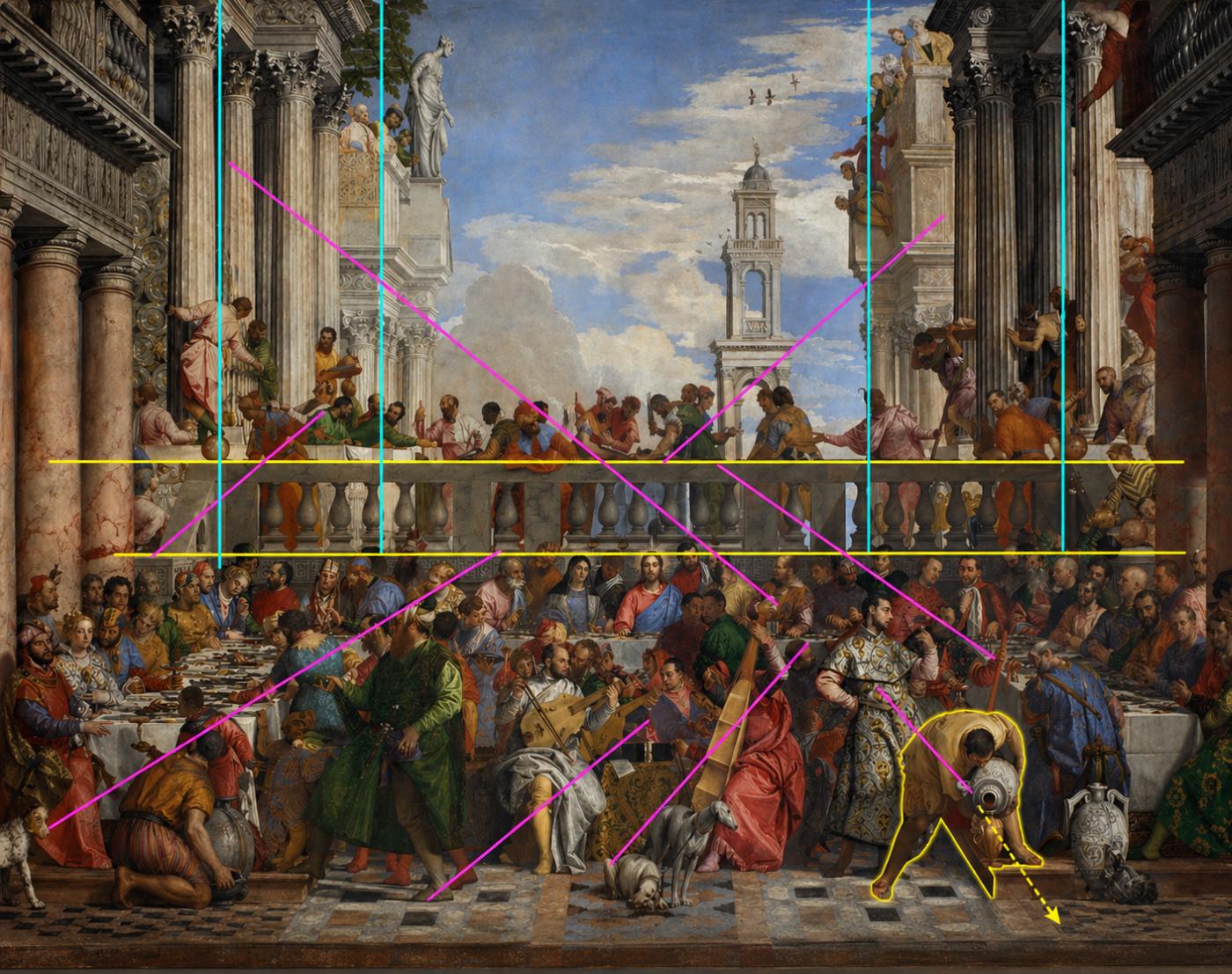
The painting is structured around a central horizontal axis, with Christ placed at the exact center. Around him, the crowd unfolds in layers, creating a sense of depth and movement.
Veronese uses linear perspective, with architectural lines, columns, balustrades, and terraces, converging subtly toward the central figure of Christ. This technique not only reinforces his importance but also creates the illusion of a vast, believable space extending beyond the canvas.
These perspective lines, combined with the elevated viewpoint, allow you to take in the entire scene as if you were a privileged guest overlooking the banquet. Veronese uses architecture to guide your eye across the scene, almost like a director guiding a camera.
A Celebration of Colors and Textures of "Cana" (16th century Venice)
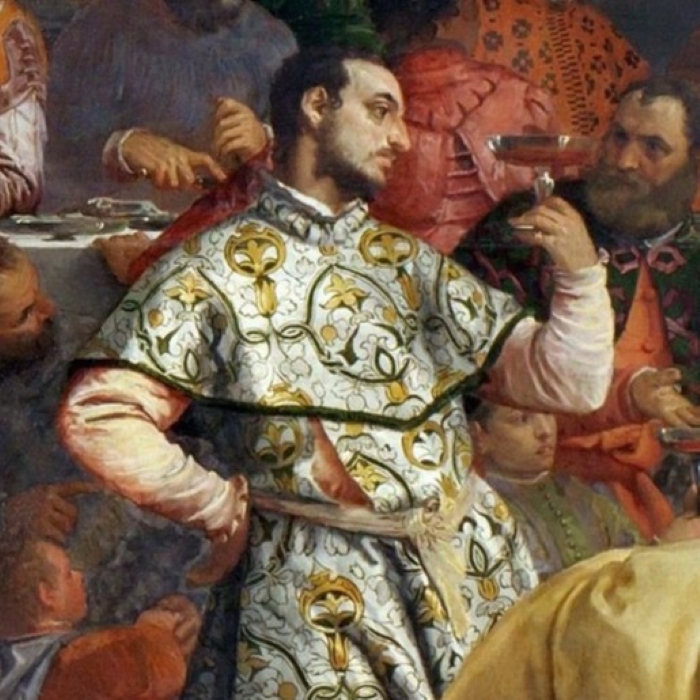
The shimmering silks, jewels, glassware, and marble are rendered with remarkable precision, reinforcing the sense of luxury and celebration.
The palette remains rich yet balanced, with deep blues, reds, and golds guiding your eye across the scene. Notably, Veronese’s commission required the use of ultramarine made from lapis lazuli, a pigment imported from Afghanistan and more expensive than gold at the time. This exceptional material, along with other costly pigments and fine details, reflects both the prestige of the commission and Venice’s immense wealth.
Who are the Figures in The Wedding at Cana?
Despite the presence of over 130 figures, the painting never feels chaotic. Every gesture, gaze, and interaction contributes to a carefully choreographed whole.
In our view, this is where Veronese’s genius truly lies by creating order within this abundance, a visual reflection of divine harmony and Venetian society.
Jesus Christ & Virgin Mary
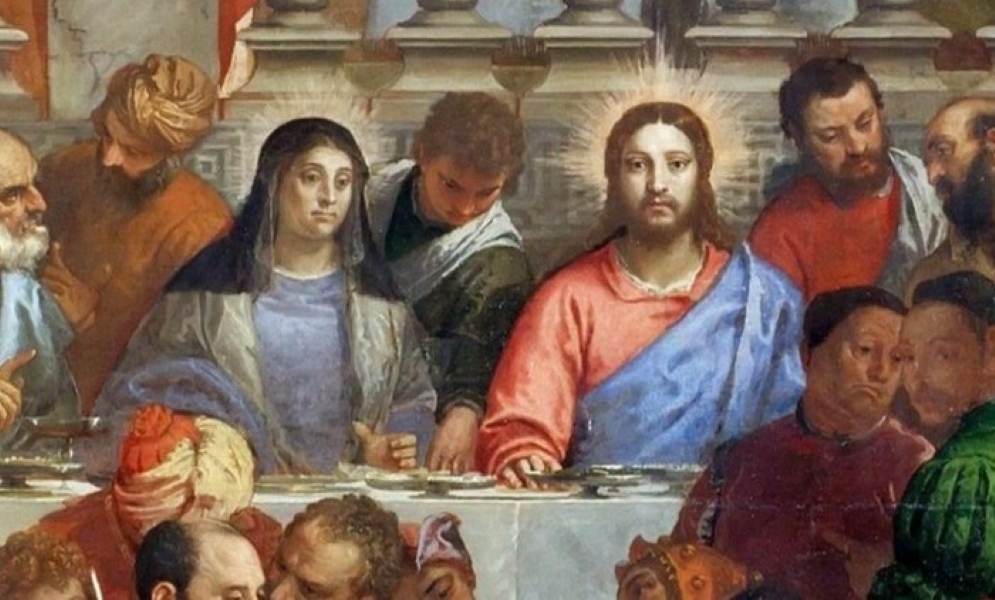
At the center, you will find Jesus Christ, serene and withdrawn, embodying quiet authority amid the surrounding movement. Although Christ occupies the exact center of the composition, he still blends into the scene, inviting viewers to explore what’s happening around him.
Beside him sits the Virgin Mary, who traditionally initiates the miracle, her presence both discreet and essential. Both wear the symbolic halo of light given to saints and other holy figures in Western art.
The Bride & Groom
In a traditional depiction of a wedding, the bride and groom would normally occupy the central position at the table, precisely where Veronese places Christ. This artistic choice is highly symbolic: by replacing the couple with Christ, Veronese visually emphasizes the spiritual importance of the miracle over the social event itself.
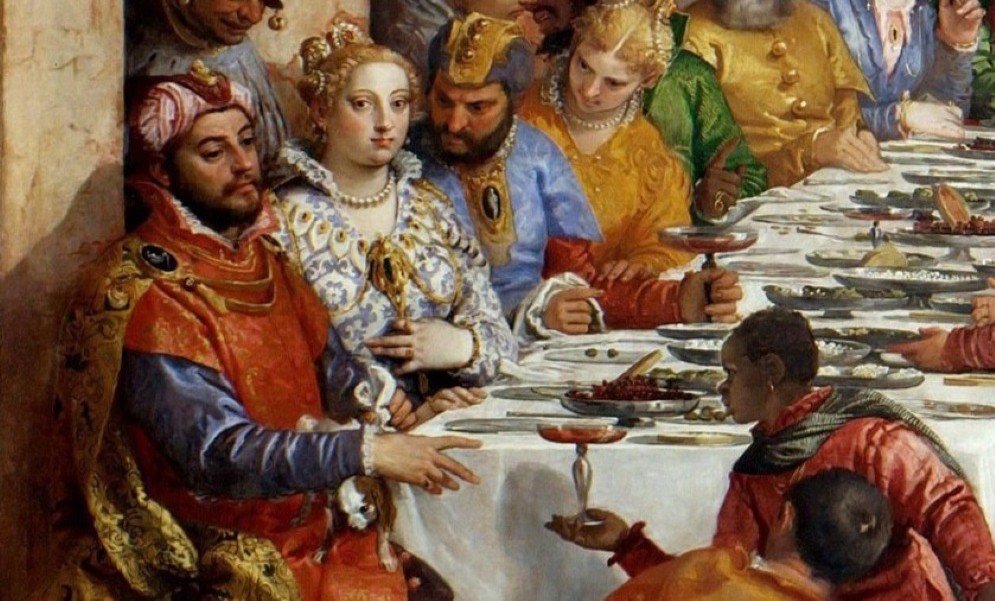
Look closely, however, and you can still sense the presence of the wedding narrative. The couple is seated at the left end of the table, and in the unfolding moment of the scene, he is about to taste the newly transformed wine offered by a servant. The bride is one of the only figures, like Christ, who is looking back at the viewer.
Veronese, Titian and Tintoretto
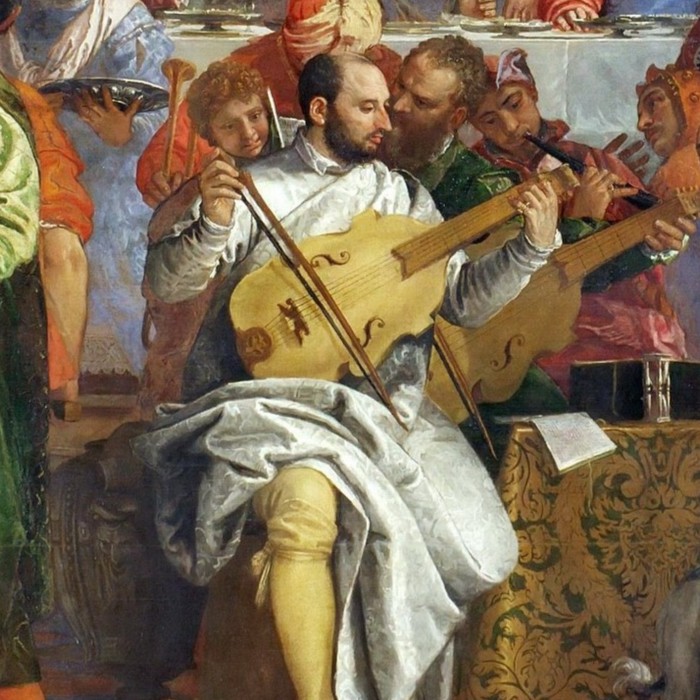
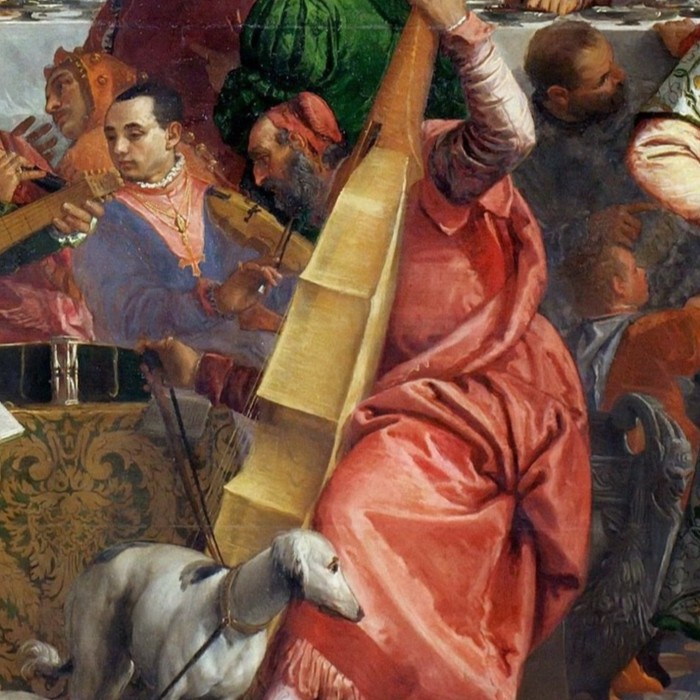
Notice in the group of musicians in the foreground, you will find Veronese himself (in white), alongside two other famous Venetian artists, Titian (in red) and Tintoretto (in blue). By inserting themselves into the scene, they elevate the status of the artist to that of an intellectual and social elite.
Rulers, Diplomats and International Guests
Veronese integrates a fascinating array of political and cultural figures, transforming the biblical event into a reflection of 16th-century power and diplomacy.
Among them, art historians believe that Veronese included figures resembling Suleiman the Magnificent (Ottoman Empire), Charles V (Holy Roman Emperor), Francis I of France, and Mary I of England. However, some of this may be speculation developed over centuries or over-identification.
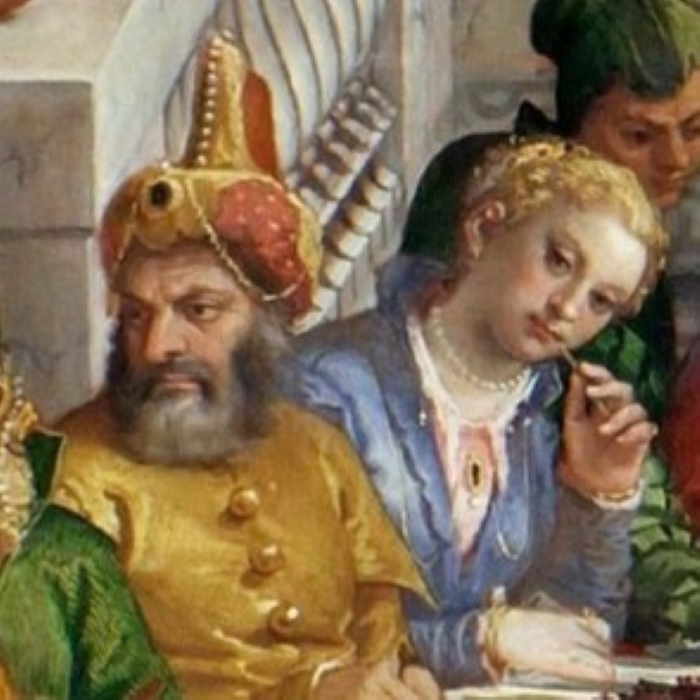
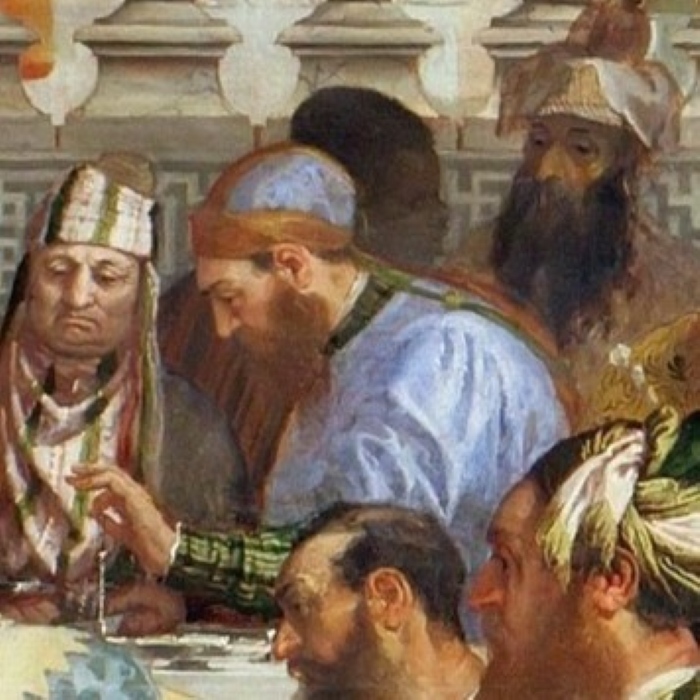
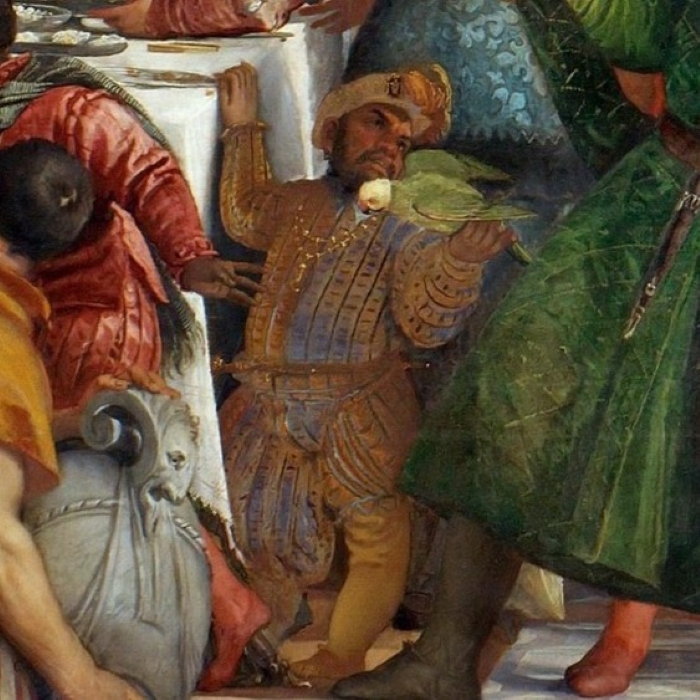
Look closely and you will notice figures dressed in Ottoman, Persian, and African attire, as well as various servants, dwarfs, nobles, and merchants. Each group reflects a different layer of Venetian society and its international connections.
This extraordinary diversity is not decorative but intentional as it reflects the reality of Veronese’s time.
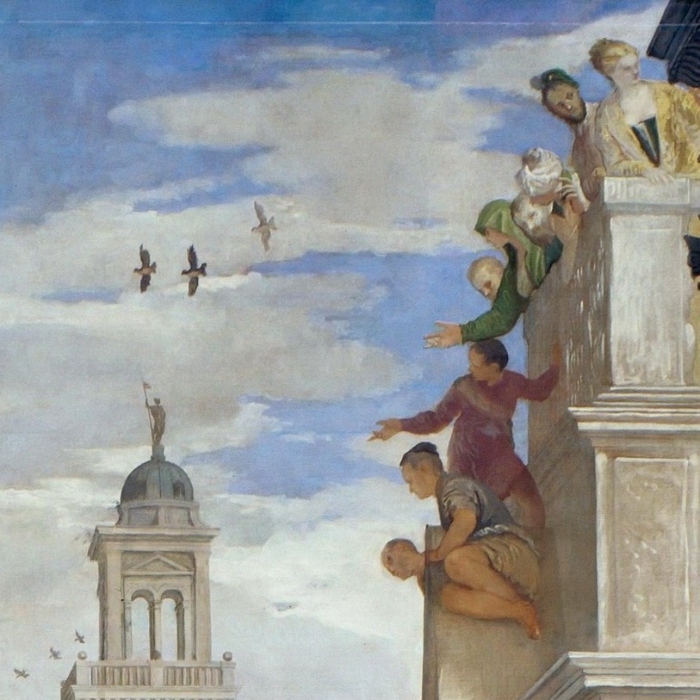
A final note worth keeping in mind as you observe the painting: many of the figures in the background are not individually identifiable, yet they are essential. They create a sense of liveliness, noise, and movement, much like a real banquet. Rather than focusing only on the central figures, allow your eye to wander. This is where the painting truly comes alive.
Why Is The Wedding at Cana in the Louvre?
As it was commissioned for the monastery of San Giorgio Maggiore in Venice, the painting remained there until the fall of Venice to Napoleon in 1797.
It was then seized by French troops as part of the Napoleonic art acquisitions, a vast campaign to bring Europe’s greatest masterpieces to Paris. At this time, the French argued that these masterpieces of art were in need of better conservation and had been neglected. They believed themselves to be the heirs and rightful caretakers of Western European Patrimony.
However, transporting such an enormous canvas was no simple task. In order to move it across the Alps, the painting was cut into several pieces, rolled, and carefully shipped to France, where it would be reassembled and sewn back together.
After Napoleon’s defeat at Waterloo in 1815, many looted artworks were returned to their countries of origin. Venice requested the return of The Wedding at Cana. However, Dominique Vivant Denon, the ambitious director of the Louvre, stated that the painting was too fragile to be moved again after its initial transport. Instead, France offered a replacement by sending a similar painting by French artist Charles Le Brun to Venice.
Instead, there is now a copy in the monastery where the original once was.
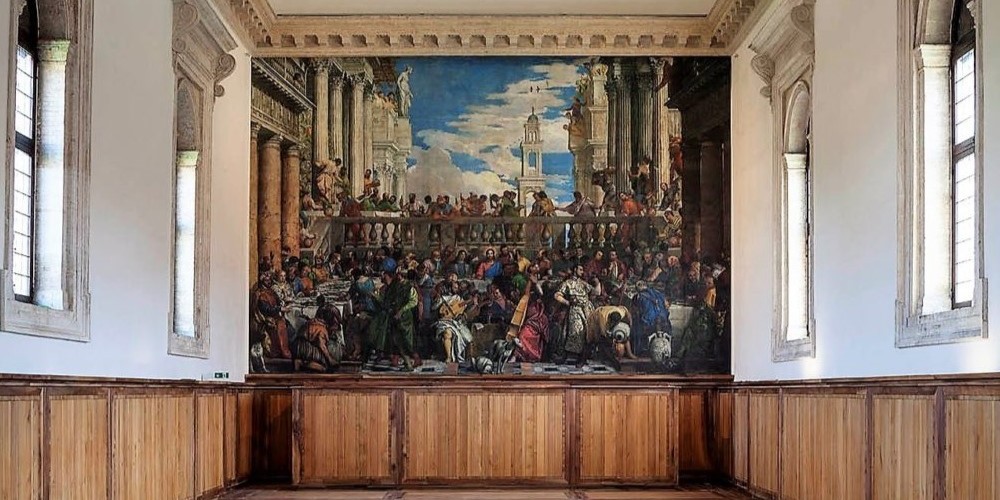
The painting has been moved outside of the Louvre twice more, although returned. During the climax of the Franco-Prussian War (1870–71), Paris was beseiged, but the painting had been moved to the city of Brest in Brittany. The painting was evacuated again during World War II, right before the Nazi Occupation force arrived in Paris in 1940. Due to decisive actions by director Jacques Jaujard, many works, like this one, were put “in storage” and then transported around the south of France to prevent Nazi plunder. Several other notable works were sent out of Paris, including the Winged Victory of Samathrace and Venus de Milo.
Where Is The Wedding at Cana in the Louvre?
You will find The Wedding at Cana in the Denon Wing, the most prestigious wing of the Louvre named after the aforementioned Dominique Vivant Denon, in the Salle des États, which is the very room that holds the Mona Lisa.
Reaching it is surprisingly simple. As you walk through the Louvre, follow the signs for the Mona Lisa—they will naturally lead you through the Grand Gallery, one of the most iconic corridors of the museum. From there, you will enter the Salle des États almost effortlessly.
Like most visitors, you may instinctively move toward the Mona Lisa. But here is our advice: once you enter the room, turn around.
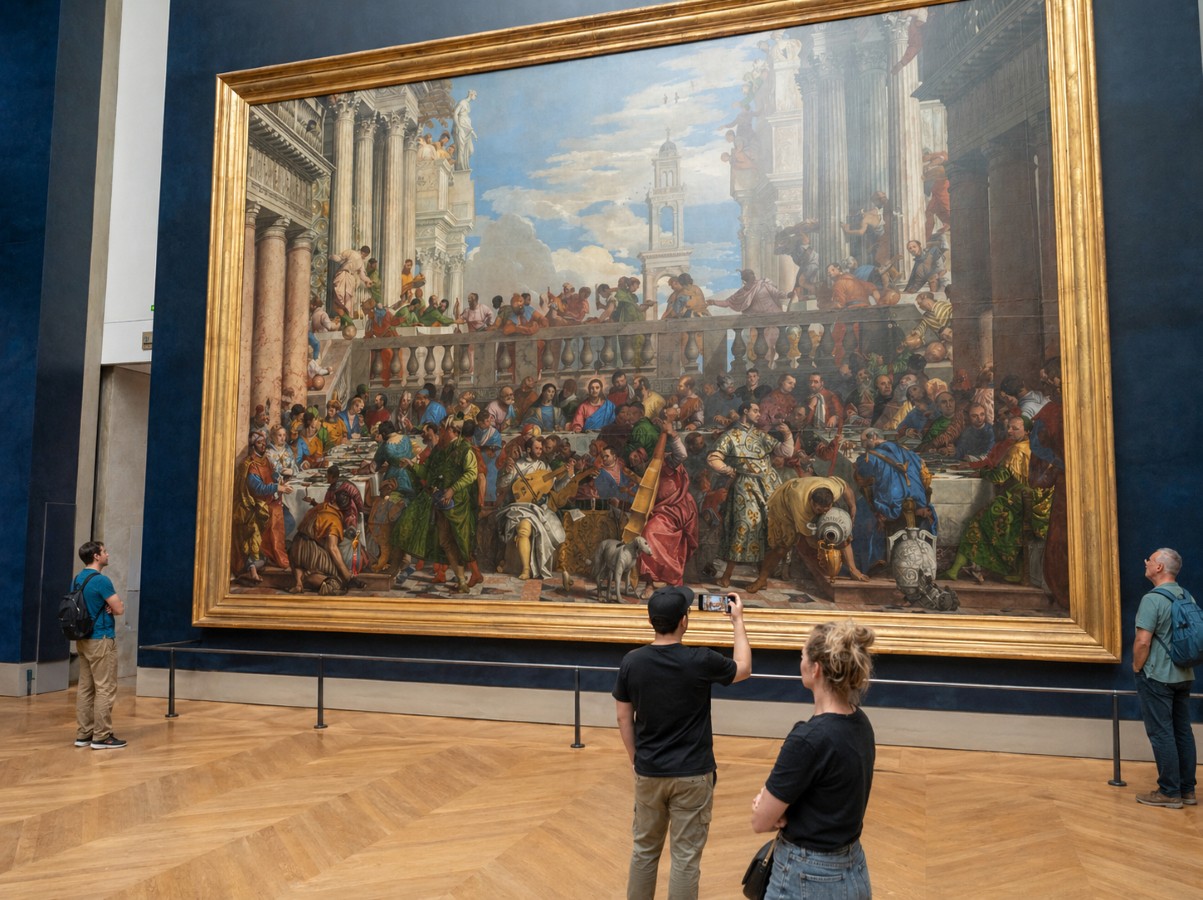
Facing you, spanning the entire wall, is Veronese’s masterpiece. Its scale, light, and energy create a striking contrast with the smaller, more intimate portrait behind you.
To truly appreciate The Wedding at Cana, you should step back and take your time. The room itself can be crowded, and without some context, it is easy to overlook the richness of what you are seeing. We recommend you stand at different distances to appreciate both the details and the full composition.
After you are finished taking in the scene, look around the room to see some other Venetian masters in the Louvre for a richer, more refined perspective of the style and time period.
If you explore the Louvre Museum at night, this room will be much emptier, allowing better viewing of this grand painting!
Frequently Asked Questions About The Wedding at Cana by Veronese
The Wedding at Cana was painted by Paolo Veronese, also known as Paolo Caliari, in 1563. He was one of the leading painters of the Venetian Renaissance.
The painting depicts the biblical wedding feast at which Jesus performs his first miracle by turning water into wine, as told in John 2:1–11.
It is displayed in Room 711, the Salle des Estates, on Level 1 of the Denon Wing, directly opposite the Mona Lisa.
The painting measures 6.77 meters high by 9.94 meters wide, or approximately 22.2 by 32.6 feet. It is the largest painting in the Louvre.
Veronese included approximately 130 figures, ranging from biblical characters and musicians to servants, nobles and international guests.
French troops seized the painting in Venice in 1797 during Napoleon’s Italian campaign. After Napoleon’s defeat, it was not returned, officially because transporting the enormous canvas again was considered too dangerous.
Yes. The two paintings face each other in the Salle des Estates. Most visitors initially look toward the Mona Lisa, while Veronese’s much larger painting occupies the wall behind them.
Plan Your Visit to Step Inside this historical moment at the Louvre!
Standing before The Wedding of Cana is impressive. Understanding it transforms everything.
Imagine discovering this masterpiece with a licensed expert who reveals the hidden symbols, political staging, and human drama behind every figure. Imagine moving seamlessly through the Louvre, the world’s busiest museum.
From priority access to a private guide and chauffeur, every detail is crafted for discretion, comfort, and intellectual depth with Paris to Versailles Private Tours.
Louvre Through the Ages
Learn more about the fascinating history and lavish royal lives with your expert guide!