
A Paris pastry menu can feel overwhelming at first, especially when you are faced with a display full of unfamiliar names and choices. This mini-guide is designed to help you understand what you are looking at, how pastries are traditionally enjoyed in Paris, and what each item represents within French food culture.
Rather than listing (too many) trends or fashionable addresses that are more about the visual than the taste, we focus on the classic pastries you are most likely to encounter during your stay. Knowing how to read a Paris pastry menu allows you to order with confidence and appreciate these everyday rituals the way Parisians do.
Table of Contents
- 1 Understanding a Paris Pastry Menu
- 2 Favorite French Viennoiserie on our Essential Paris Pastry Menu
- 3 Our Favorite French Pastries on our Essential Paris Pastry Menu
- 4 When to Enjoy Each Item on a Paris Pastry Menu
- 5 A Paris Pastry Menu as a Gateway to Parisian Life
- 6 FAQ – Paris Pastry Menu
- 7 Enhance Your Parisian Getaway With Exclusive Private Tours
Understanding a Paris Pastry Menu
Before choosing what to order, it helps to understand how a Paris pastry menu is organized. Most bakeries follow the same logic, separating pastries by type and by the moment of the day they are traditionally eaten. Once you recognize these categories, understanding the display becomes much easier.
Pastry Menu Terms - Pâtisserie vs. Viennoiserie
Stepping into a Parisian Boulangerie, you may notice that there are two distinct sections in the display case (or even two different display cases). These are to distinguish the Viennoiserie from the Pâtisserie, but what exactly are they?
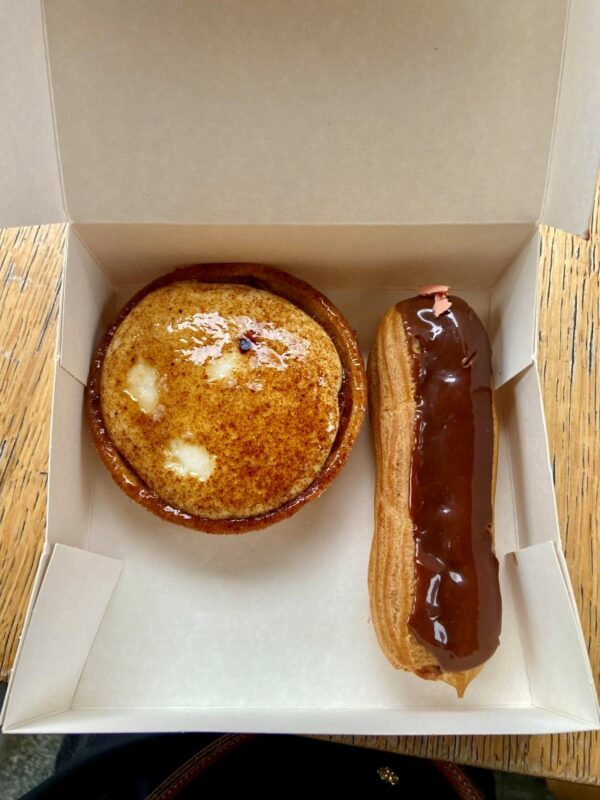
The word Pâtisserie is used to describe pastries and as well the shop they are sold in! We use this word quite liberally in English, but it actually refers to an umbrella of intricate cakes, tartes, and other sweet treats that require technical skill and precise preparation, and are typically enjoyed as desserts or afternoon pastries.
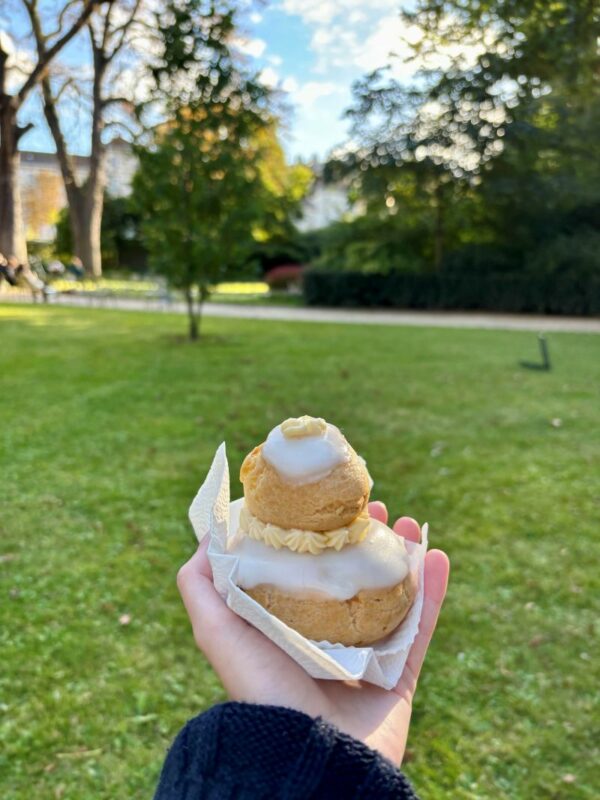
Viennoiserie refers to breakfast pastries that are made in the traditional style of Vienna, Austria. Although not originally French, this style of pastry became popular in France in the 19th century after its introduction by Austrian bakers, and was gradually adapted using French ingredients and techniques, particularly butter-rich laminated dough.
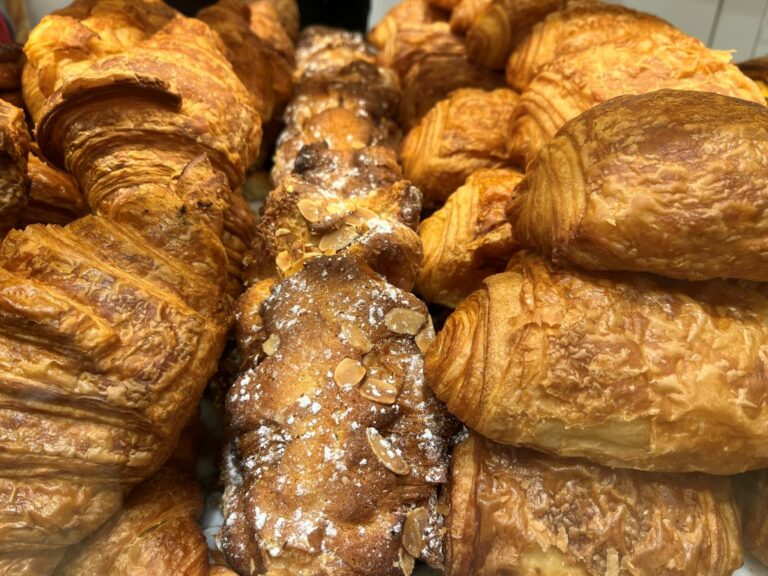
Favorite French Viennoiserie on our Essential Paris Pastry Menu
An Iconic Paris Pastry ~ Croissant
A croissant is a viennoiserie by definition and is widely considered the most iconic French breakfast pastry. Made from laminated dough, it sits somewhere between bread and puff pastry and is closely associated with Parisian morning routines.
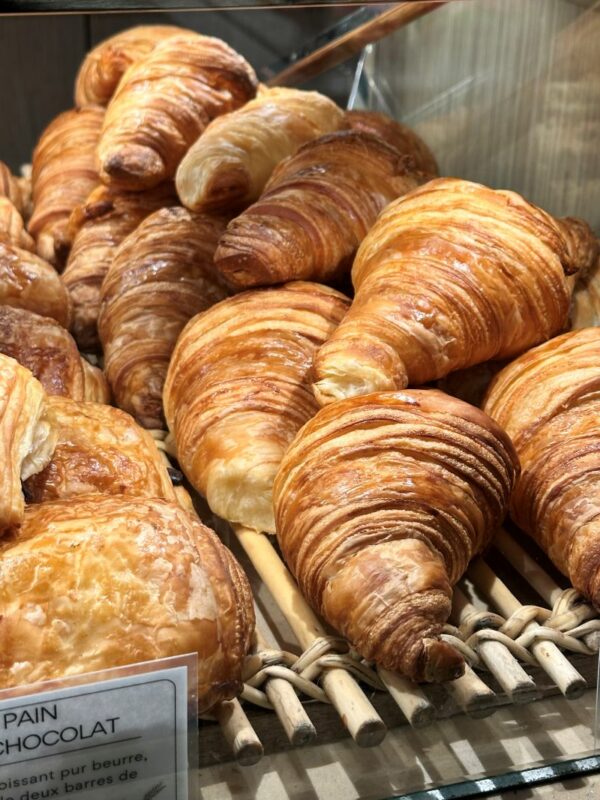
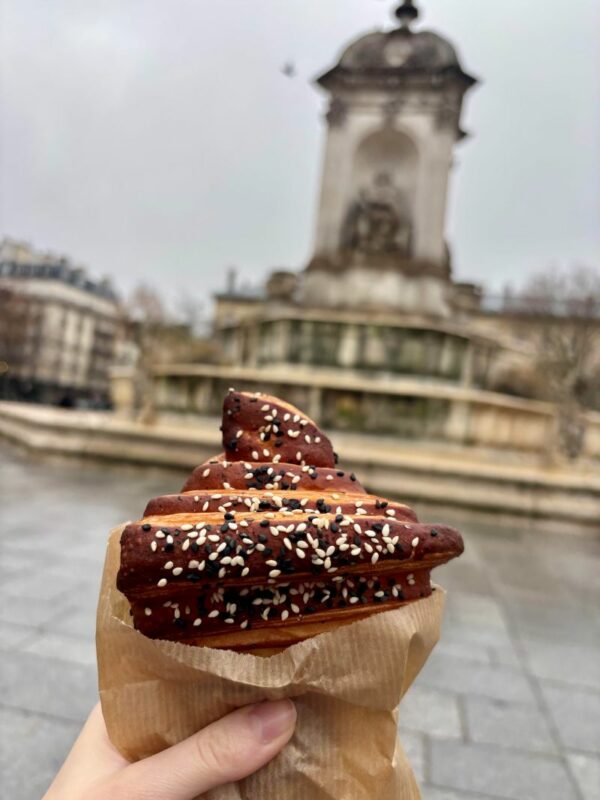
Although strongly linked to France today, the croissant has Austrian origins. It was inspired by the kipferl, a crescent-shaped bread that dates back to the Middle Ages. Unlike the modern croissant, the kipferl was not made with laminated dough and had a denser texture. It is rumored that Marie Antoinette requested that these Viennese delicacies would be served at Versailles, even bringing her Austrian pastry maker to court.
The other theory is that the croissant developed in Paris during the 19th century, particularly after Austrian baker August Zang opened the Boulangerie Viennoise in 1839. His Vienna-style pastries were quickly adopted by Parisian bakers, who adapted the techniques using French butter and baking methods. By the late 19th century, the word croissant appeared in dictionaries, and by the 20th century the flaky, butter-rich version had become standard.
In modern boulangeries, you can buy either a croissant pur beurre or a croissant ordinaire, which is made from margarine instead of butter! Always choose the croissant au pur beurre, unless you’re vegan of course. Some of our favorite croissants are at La Boulangerie Moderne at 16 Rue des Fossés Saint-Jacques, 75005 Paris.
A Pastry Menu Must ~ Pain au Chocolat
The sweeter sister of the croissant, this ultra buttery viennoiserie includes melted sticks of bakers’ chocolate, which are called barres de chocolat. Like the croissant, it is made from laminated dough, folded with butter to create thin, flaky layers. The main difference lies in its shape and filling: rectangular rather than crescent-shaped, with one or two bars of chocolate placed inside before baking.
The pain au chocolat became popular in Paris in the late 19th century, at the same time as the croissant, as Viennese-inspired pastries were adopted and refined by French bakers. Today, it is a staple of the Paris pastry menu and a common breakfast choice for both adults and children, often enjoyed plain or with coffee.
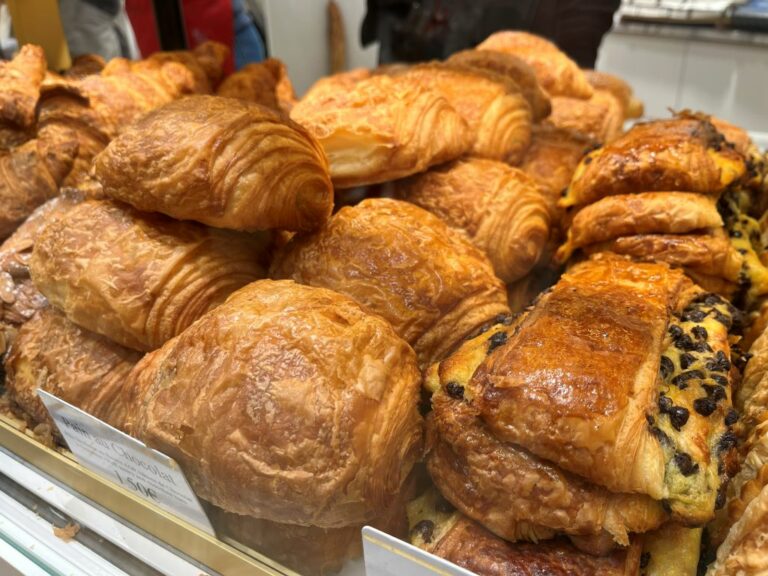
Be wary! In the south western part of France, like in the city of Toulouse, they refer to the pain au chocolat as chocolatine. Using the wrong term in the wrong place might raise some eyebrows (or just out you as not a local). Our favorite pain au chocolat is at Mamiche, at 45 Rue Condorcet, 75009 Paris. It can be a little crowed, but for good reason! If you’re looking for something more savory as well they do a killer croissant jambon-fromage.
Our Favorite French Pastries on our Essential Paris Pastry Menu
A Pastry Menu Staple ~ Éclair
The éclair is one of the most recognizable pastries you will see on a Paris pastry menu. Its name means “flash,” a reference often explained by how quickly it is eaten once served.
An éclair is made from pâte à choux, the same dough used for profiteroles, another French delight. Once baked, it is filled with pastry cream and finished with a thin layer of icing. Traditionally, the most common flavors are chocolate and coffee, and these classics remain the most widely ordered in Paris today.
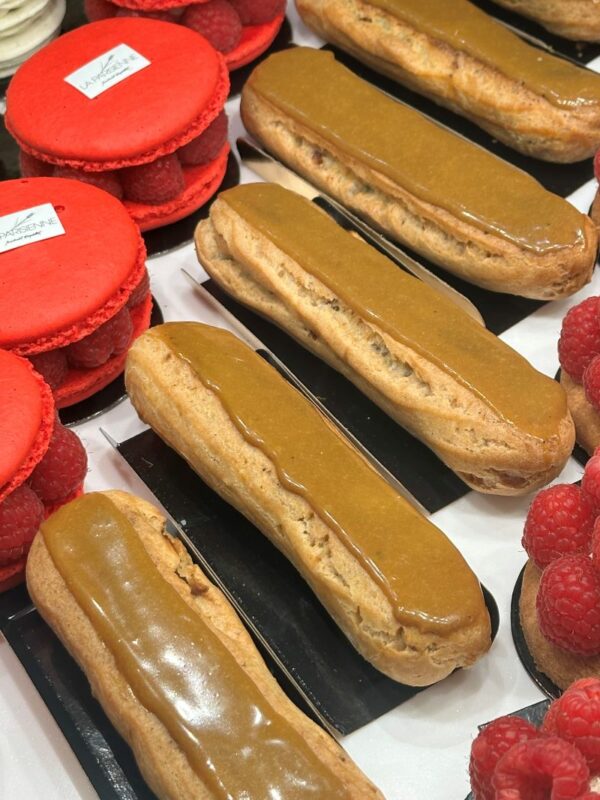
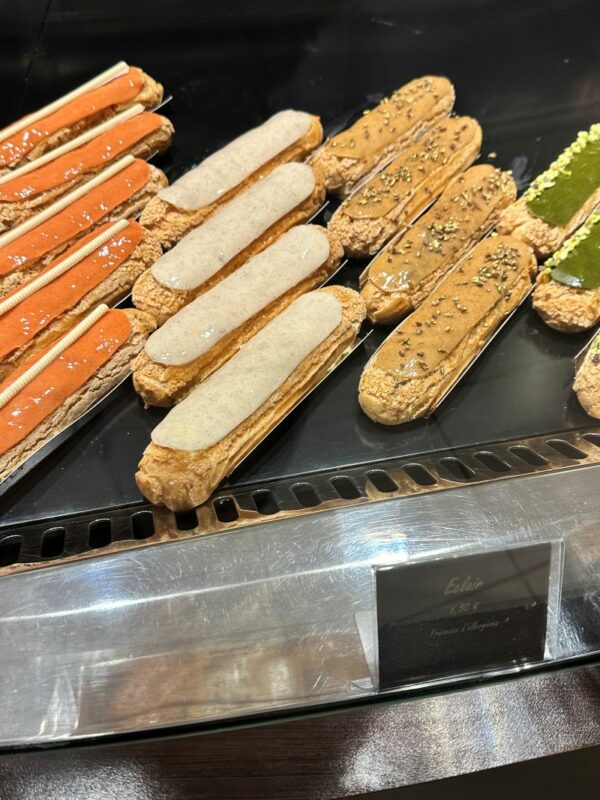
On a Paris pastry menu, éclairs are usually displayed individually and meant to be enjoyed as a dessert or an afternoon treat rather than in the morning. While modern pâtisseries experiment with seasonal flavors and decorative toppings, many Parisians still gravitate toward the classic chocolate éclair as a reference point for quality.
The éclair as we know it appeared in the 19th century, during a period when French pastry was becoming more codified and techniques were being standardized. Unlike more rustic pastries, the éclair reflects precision: evenly baked choux, a smooth filling, and a clean, glossy finish.
We have two different recommendations for éclairs in Paris. The first is the boulangerie Carl Marletti, located in the th arrondissement. Our second recommendation, which is on the other side of the river is L’éclair de Génie in Le Marais. This shop specializes in just éclairs, so they get creative with their flavors!
The Difficult, yet Delicate French Pastry ~ Mille-Feuille
The mille-feuille is a classic French pastry that appears on nearly every traditional Paris pastry menu. Its name translates to “a thousand layers,” a reference to the many thin layers of puff pastry that define its structure.
A traditional mille-feuille is composed of alternating layers of crisp, laminated puff pastry and smooth pastry cream, most often flavored with vanilla. The top layer is typically finished with icing or powdered sugar, depending on the style of the pâtisserie. Unlike more elaborate desserts, the mille-feuille relies on contrast: crunch against cream, richness balanced by restraint.
The pastry became popular in the 19th century, at a time when French pastry techniques were becoming more formalized. Because it leaves little room for error, the mille-feuille is often seen as a benchmark for a pastry chef’s technical skill. The pastry must be crisp without being dry, and the cream generous without overwhelming the structure (or causing any ‘soggy bottoms or middles’).
On a Paris pastry menu, the mille-feuille is usually enjoyed as a dessert or afternoon pastry. While some modern versions introduce fruit or flavored creams, many Parisians prefer the classic vanilla version as a reliable indicator of quality.
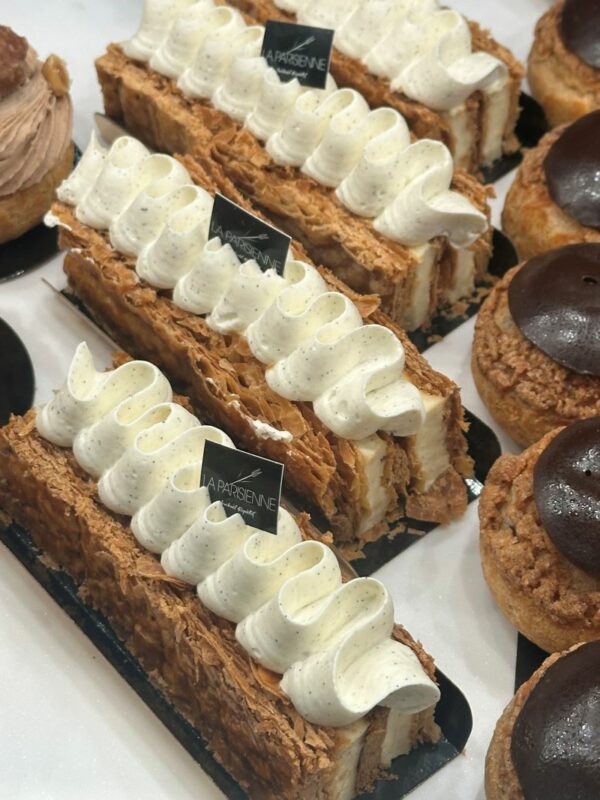
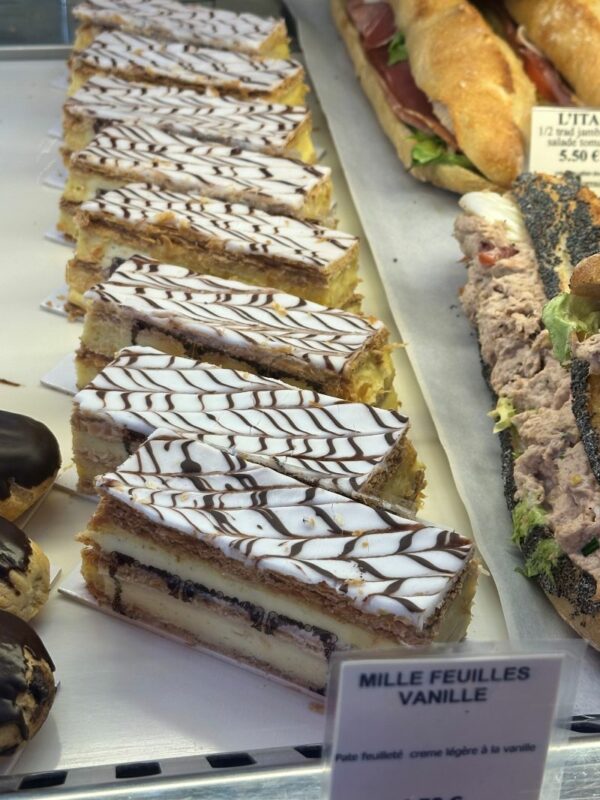
One of our favorite mille feuilles is close to our office at boulangerie La Parisienne! They have locations scattered throughout the city as well.
A French Pastry to Remember ~ Madeleine
The madeleine is a small sponge cake that holds a quiet but important place on a Paris pastry menu. Recognizable by its shell shape, it is simpler than many classic French pastries, yet deeply tied to everyday French culture.
There is a popular saying in French, ‘The Madeleine de Proust’, coined by the famous author Marcel Proust, that describes smells, tastes, sounds reminding you of your childhood or bringing back emotional memories from a long time ago. In his novel, Remembrance of Things Past, Proust explains how vivid memories from his childhood are brought on when he sips a tea that has the crumbs of Madeleines.
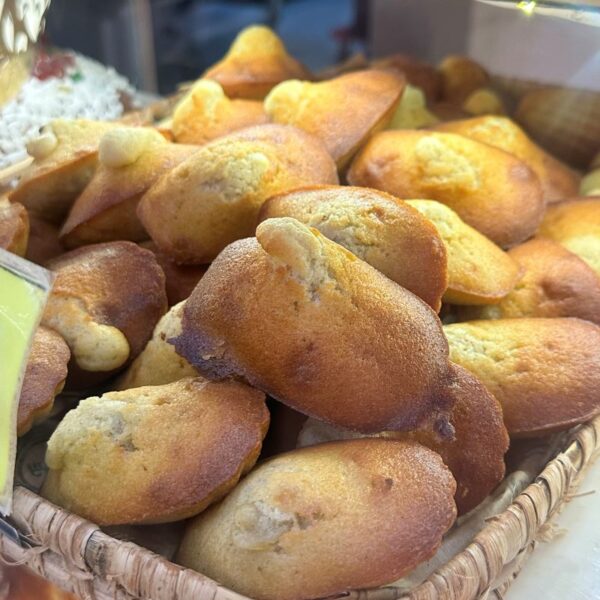
Traditionally made with eggs, butter, sugar, and flour, the madeleine has a soft, tender crumb and a lightly crisp exterior when baked correctly. It is often flavored subtly, most commonly with lemon zest, vanilla, or orange blossom, rather than bold or heavy fillings.
Unlike pastries that are reserved for dessert, the madeleine is typically enjoyed as a snack or with coffee or tea, sometimes in the morning, sometimes in the afternoon. It is less about indulgence and more about familiarity.
While madeleines are sold in many bakeries and pâtisseries, they are also closely associated with home baking, which contributes to their reputation as a comforting and understated classic rather than a showpiece pastry.
If you want to try multiple variations of Madeleines beyond vanille, we’d tell you to head to Le Comptoir de Madeleine at 17 Rue Victor Massé, 75009 Paris. They offer 4 different flavors (including one filled with salted caramel) and then 5th ‘madeleine of the moment’ that changes seasonally.
A Fresh Squeeze on a Pastry Menu ~ Tarte au Citron
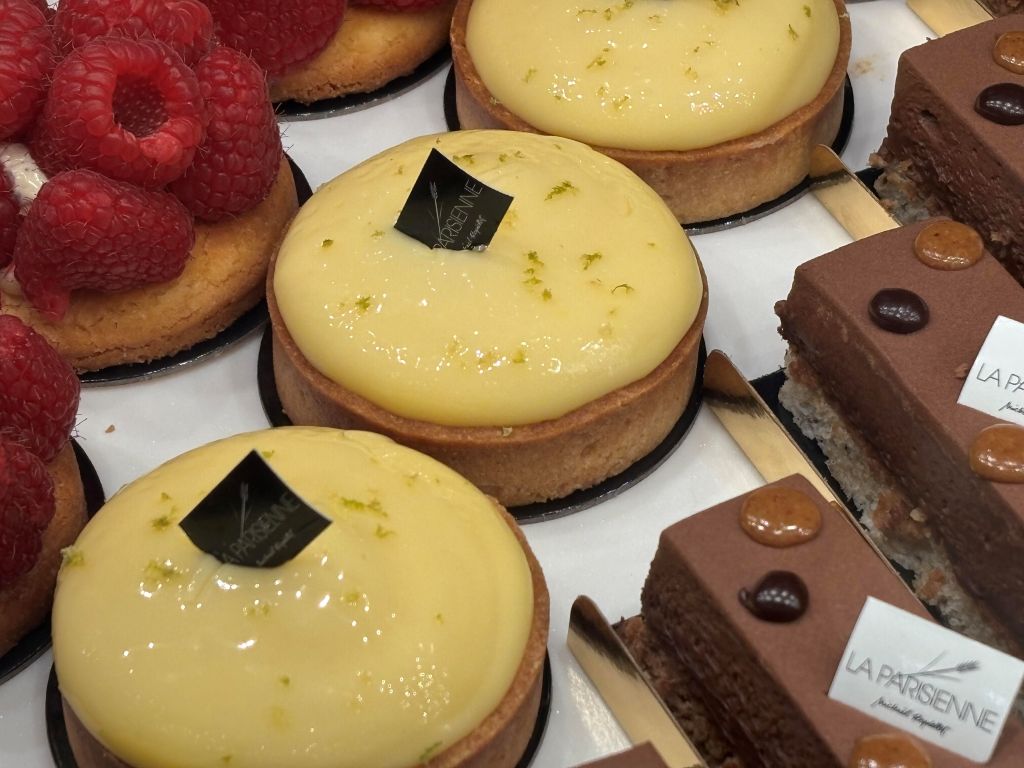
The tarte au citron is a classic French dessert that you will frequently find on a Paris pastry menu, particularly in traditional pâtisseries. It is valued for its balance between sharpness and sweetness, offering a contrast to richer, cream-based pastries.
A traditional tarte au citron consists of a crisp shortcrust pastry shell filled with a smooth lemon cream made from eggs, sugar, butter, and fresh lemon juice. The filling should be silky and well-set, with a pronounced citrus flavor that remains refreshing rather than overpowering.
The tarte au citron became popular in France in the 20th century, as lighter, fruit-forward desserts gained favor. Its appeal lies in precision: a pastry shell that remains crisp, a filling that is neither too acidic nor too sweet, and a clean finish.
On a Paris pastry menu, the tarte au citron is typically enjoyed as a dessert or afternoon pastry. Some versions are topped with a light meringue, while others are left plain to highlight the intensity of the lemon. Many Parisians prefer the simpler version, where the quality of the ingredients speaks for itself.
If you want to try multiple variations of Madeleines beyond vanille, we’d tell you to head to Le Comptoir de Madeleine at 17 Rue Victor Massé, 75009 Paris. They offer 4 different flavors (including one filled with salted caramel) and then 5th ‘madeleine of the moment’ that changes seasonally.
A Pastry Menu of its own ~ Macaron
The macaron is one of the most visually recognizable items on a Paris pastry menu, often associated with colorful displays and gift boxes. Despite its modern image, the macaron has a long history in France, dating back several centuries.
A traditional macaron is made from two almond meringue shells, crisp on the outside and soft on the inside, sandwiched around a filling such as ganache, buttercream, or fruit curd. The shells are made from almond flour, egg whites, and sugar, and their texture depends heavily on precise technique and timing.
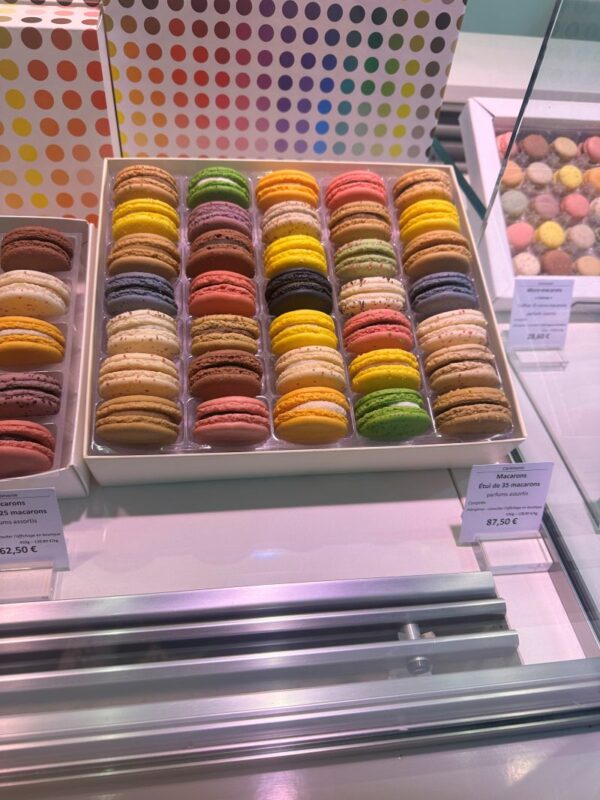
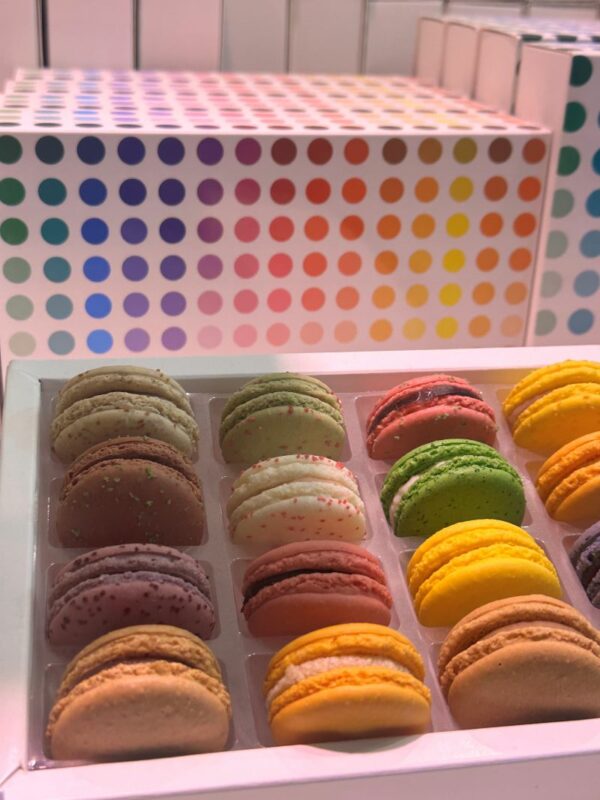
Macarons evolved significantly in Paris during the 20th century, when pastry chefs began pairing the shells and experimenting with a wider range of flavors. Today, you will find both classic flavors such as chocolate, coffee, vanilla, and pistachio, as well as more creative or seasonal variations, such as Pierre Hermé’s Foie Gras Seasonal Flavor in 2024.
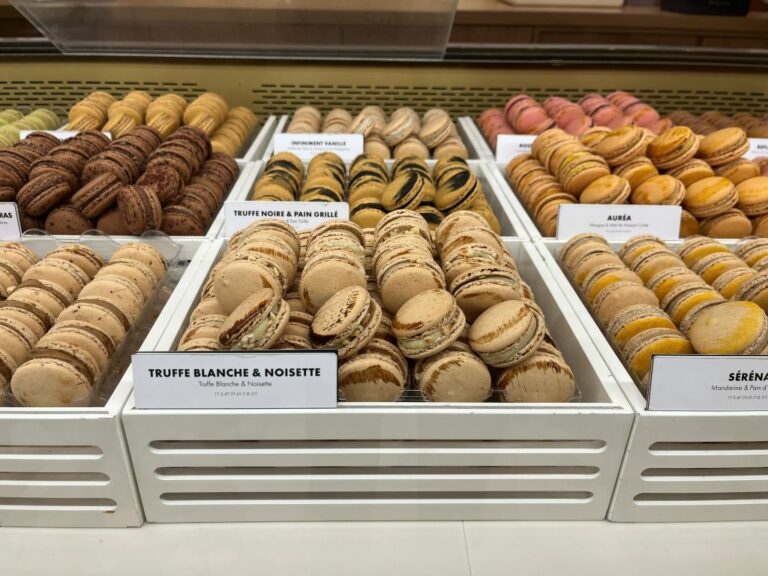
On a typical Paris pastry menu, macarons are usually enjoyed as a small dessert or purchased in assortments to take away. While often perceived as a luxury pastry, many Parisians see them as an occasional treat rather than an everyday indulgence.
We recommend of course Pierre Hermé, but if you’re looking for a more local address we also suggest Richart, a chocolate shop that also specializes in some seriously delicious Macarons. They are located at 27 rue Bonaparte, 75006 Paris.
A Marvelous Menu Choice ~ Les Merveilleux
Les Merveilleux are a pastry originally from northern France, particularly associated with the city of Lille, but they have become increasingly visible on Paris pastry menus in recent years.
This dessert is made from layers of crisp meringue and whipped cream, often coated on the outside with chocolate shavings, speculoos crumbs, or other toppings. Despite its rich appearance, a well-made merveilleux is surprisingly light, relying on texture rather than heaviness!
Historically, the pastry is said to take its name from the “Incroyables” and “Merveilleuses,” extravagant figures of post-Revolutionary France, known for their elaborate style. While the exact origin of the name is debated, the pastry itself reflects a contrast between simplicity of ingredients and careful assembly.
On a Paris pastry menu, merveilleux are typically enjoyed as a dessert and are often sold in individual portions or small assortments. Their growing popularity has led to dedicated shops specializing exclusively in this pastry, making it a more common sight in Paris than in the past.
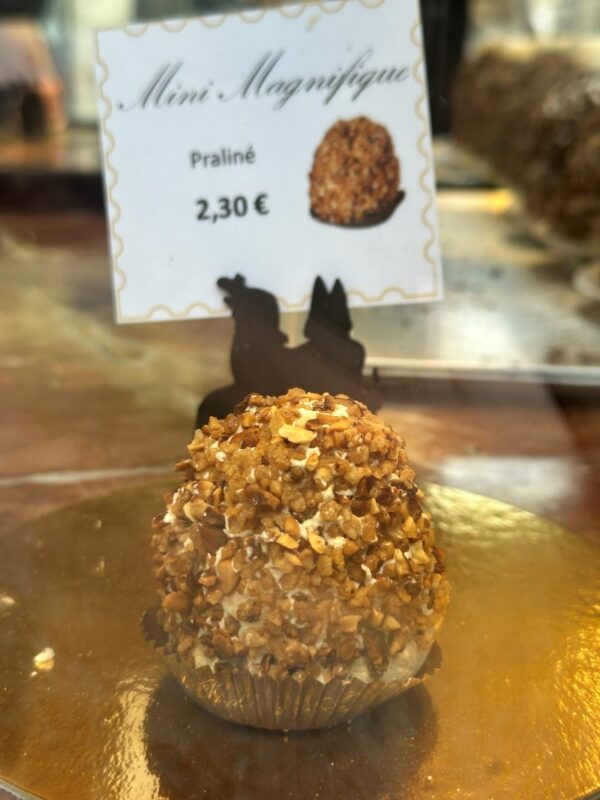
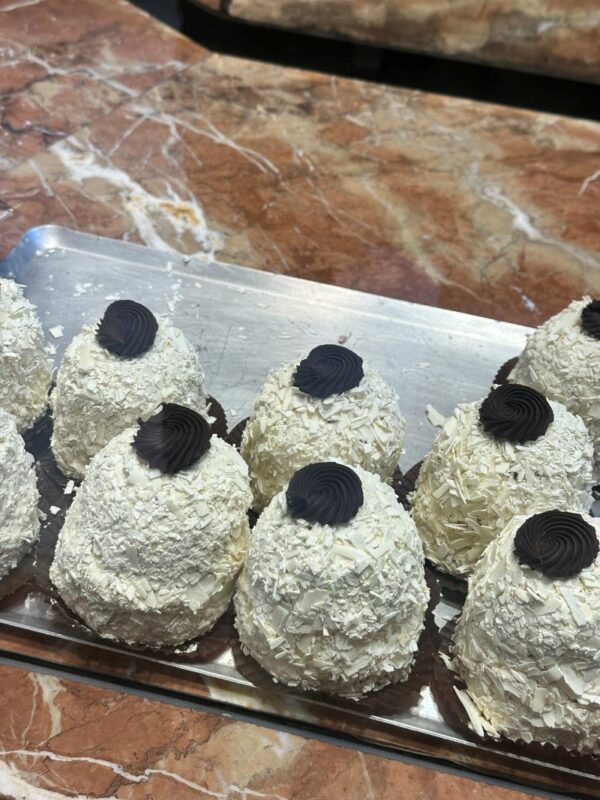
The main spot to find these light and delicious pastries is Aux Merveilleux de Fred, you can find his stores scattered throughout Paris and other major cities in France (we also recommend trying his brioche sucré too).
When to Enjoy Each Item on a Paris Pastry Menu
Morning Selections on a Pastry Menu
Morning is the traditional time for viennoiseries. Croissants, pain au chocolat, and similar breakfast pastries are usually eaten early in the day, often with coffee. In Paris, these pastries are commonly purchased on the way to work or enjoyed at home rather than as a sit-down breakfast.
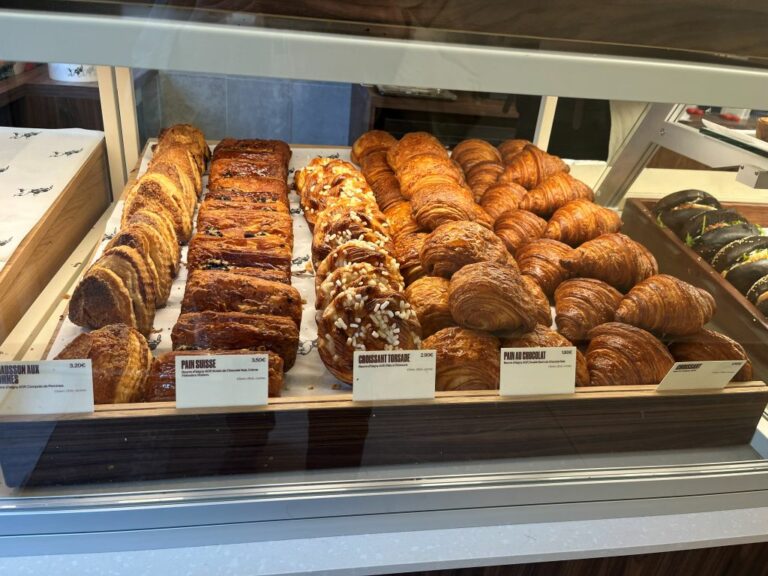
Of course, nothing can stop you from an afternoon croissant, the boulangerie worker won’t bat an eye.
Afternoon Suggestions on a Pastry Menu
The afternoon is when lighter pastries tend to appear. Chouquettes, financiers, and madeleines are typical choices, often eaten during a coffee break in the mid to late afternoon.
This is also when many Parisians visit a pâtisserie rather than a boulangerie. 4 o’clock is also widely considered l’heure de gouté, or snack-time, in France. This coincides with when children get out of school and receive a little something sweet to get them though the rest of the late-afternoon until dinner. Many french adults participate in this sweet hour as well, stopping for a little something sweet after the post-lunch slump.
Dessert Pastries
More elaborate pastries such as tartes, éclairs, mille-feuilles, and other pâtisserie items are most often enjoyed as desserts or as a more indulgent afternoon treat. These pastries are less associated with breakfast and more with a slower moment in the day, as these items are often rather challenging to eat on-the-go.
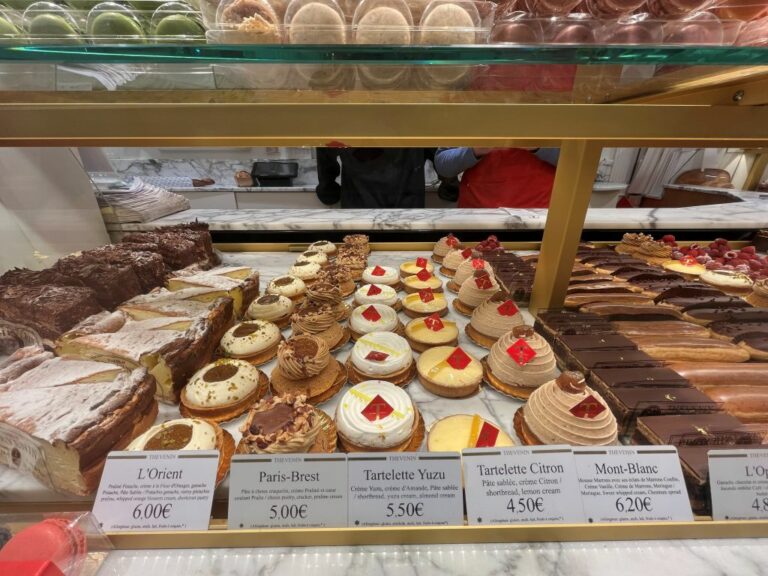
Secret Late-night Snacks
Most boulangeries in Paris close between 7:30 am and 7:30 pm, and many close one or two days per week, often on Sunday or Monday. Late at night, options are more limited, but desserts can still be found!
Crêperies, particularly in lively areas such as Rue Mouffetard, stay open late and are a common choice for a sweet option after dinner. This area is close to the historic Université de la Sorbonne, so many nights of the week you’ll see young students stopping by after an extended apéro. But bring some cash! Many of these spots have a minimum you must spend before you can use a credit or debit card, and most crêpes won’t put you over that limit.
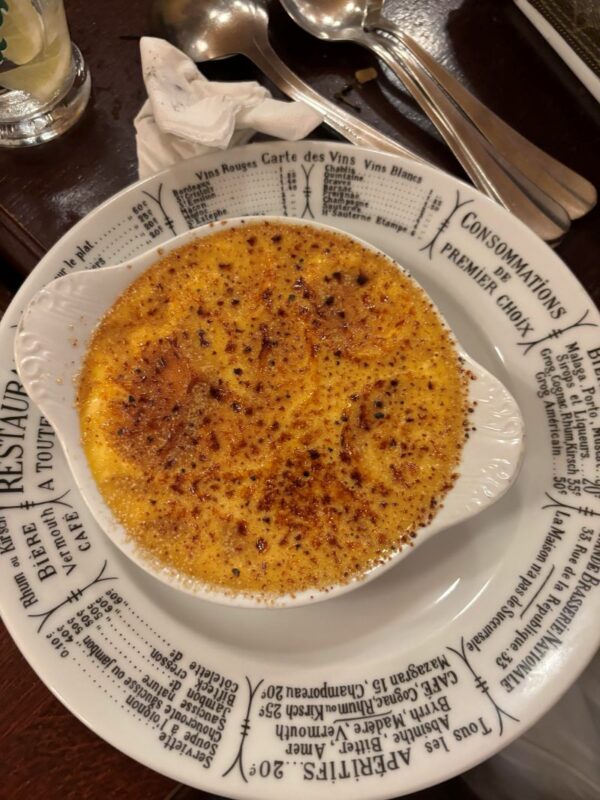
If you’re looking for a more refined sit-down experience, most classic French restaurants also offer house-made desserts. This is often the simplest way to enjoy something sweet later in the evening. Traditional addresses such as Le Comptoir du Relais, Benoit, Chez Dumonet, and Bistrot Paul Bert are known for serving straightforward, well-executed desserts like crème brûlée, profiteroles, île flottante, or chocolate mousse as part of a classic meal.
A Paris Pastry Menu as a Gateway to Parisian Life
How to order from a Paris Pastry Menu like a local
Ordering at a Parisian boulangerie can feel intimidating at first, especially if you do not speak French. In central areas of Paris, many boulangeries have staff who speak English, but the ordering process is usually quick and efficient, so it helps to know what to expect.
It is customary to greet the person behind the counter with a simple “Bonjour” before ordering. You can then point to the pastry you want and say the name if you know it, followed by the quantity. Politeness matters more than perfect pronunciation. If you want to try ordering in a full sentence here are some common phrases and their English translations:
Je vais prendre …. I am going to take….
Je voudrais…. I would want…..
J’aimerais…. I would like….
And always add a little s’il vous plaît (please) at the end!
Most pastries are ordered to take away, even if you plan to eat them nearby. Payment is usually made at the counter, and pastries are handed to you individually wrapped. Observing how locals order and following the same rhythm is often the easiest way to feel comfortable.
FAQ – Paris Pastry Menu
A boulangerie is legally required to bake bread on site and usually sells viennoiseries as well. A pâtisserie specializes in desserts such as cakes, tartes, and cream-filled pastries, and may or may not bake bread. Most of time now, these two stores are combined!
Yes! In many parts of Paris, especially central areas, staff speak English. However, starting with a simple greeting such as “Bonjour” and ending with a “Merci , aurevoir” is customary and appreciated.
Most pastries are ordered to take away. Some bakeries offer seating, but it is common to eat pastries at home, at work, or seated. It is seen as rather touristy to eat in the street, but don’t let that stop you if you’re hungry!
It is common to order one pastry per person, sometimes two if sharing or taking something for later. Ordering large quantities is less common for everyday purchases.
Enhance Your Parisian Getaway With Exclusive Private Tours
To elevate your pastry tasting, consider an exclusive private Sweet Paris Food Tour! At Paris to Versailles Private Tours, our licensed guides and dedicated chauffeurs lead you through tailor‑made experiences steeped in French heritage, refinement, and luxury.
Sweet Paris Food Tour
Learn more about the fascinating history and lavish royal lives with your expert guide!