Wait, you can visit the Louvre museum at Night? Yes!
When you visit at night, you can experience one of the most elegant and underrated cultural moments Paris has to offer. The Louvre Museum at night feels like a different institution entirely. Most visitors associate the Louvre with long lines, crowded galleries, and a hurried march toward the Mona Lisa. But in the evening, the atmosphere softens and you can to notice details that would otherwise slip past you. We invite you to explore our guide to visiting the Louvre Museum at night!
Table of Contents
- 1 Why Visit the Louvre Museum at Night?
- 2 Masterpieces that Shine at the Louvre Museum at Night
- 3 The Louvre Museum Night Opening Hours – What You Need to Know
- 4 The Louvre Museum Night Opening Hours – What You Need to Know
- 5 FAQ – Louvre Museum at Night
- 6 Enhance Your Parisian Getaway With Exclusive Private Tours
Why Visit the Louvre Museum at Night?
Louvre Nocturne - a Completely Different Atmosphere After Dark
As daylight fades, the museum becomes a quieter, more approachable space. Instead of navigating around large tour groups, you find yourself pausing naturally in front of a painting or sculpture, without pressure.
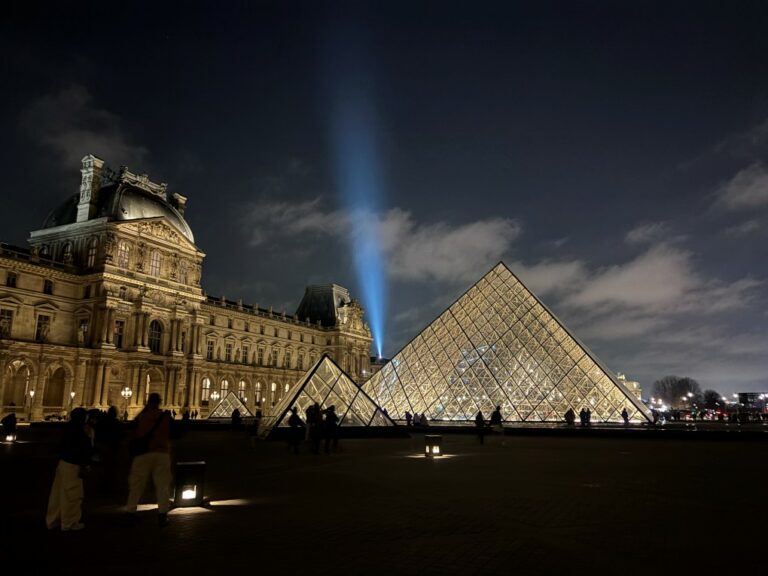
Our Expert Take: The Louvre Was Meant to Be Seen at Night
There is something about the Louvre after dark that simply makes sense. Originally a royal residence, the palace was designed for candlelight, ceremony, and spectacle. In the evening, that historic character feels more present.
There are many spaces that use artificial lighting that mimics daylight, but several halls darken after the sun goes down. This softened lighting highlights gilded frames, deepens shadows, and adds dimension to marble and canvas alike. Long corridors feel cinematic rather than overwhelming. In our experience, the Louvre Museum at night is not just a practical alternative to daytime crowds. It is, in many ways, the more atmospheric and memorable way to encounter the world’s most famous museum.
Masterpieces that Shine at the Louvre Museum at Night
The Mona Lisa in the Evening and Other Notable Works
The Louvre has 2 weekly nocturnes, or evenings when it remains open past 5PM.
This takes place on Wednesday and Friday nights, with the museum staying open until 9PM, and last admission at 8PM. That extra time may not sound dramatic on paper, but it makes a real difference in atmosphere. By early evening, the daytime tour groups have thinned out and the pace inside the galleries noticeably softens.
In addition, the first Friday of the month is free for all for nocturnal admission, (although July and August are excluded). Even on those free evenings, we strongly recommend reserving in advance. Free does not mean available, especially in Paris. But if timed well, it can be a wonderful opportunity to experience the Louvre Museum at Night with a more local crowd and a lively yet still manageable energy.
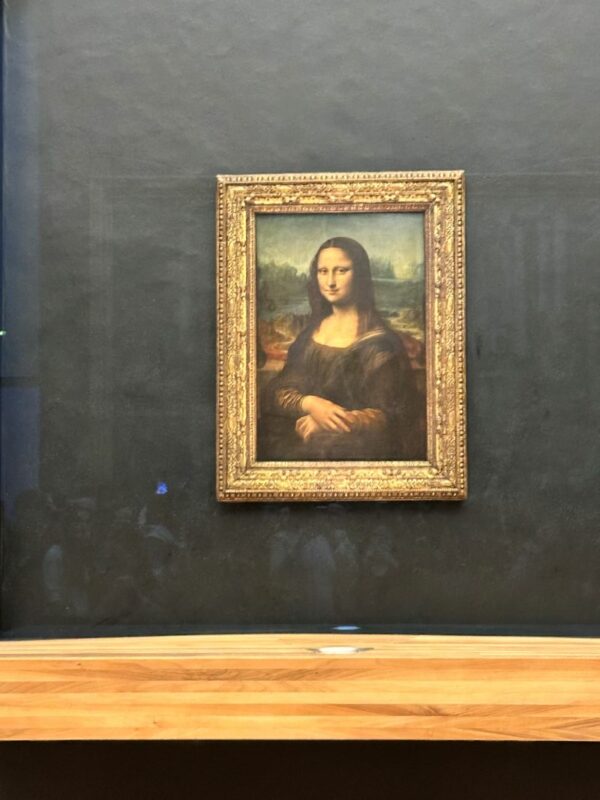

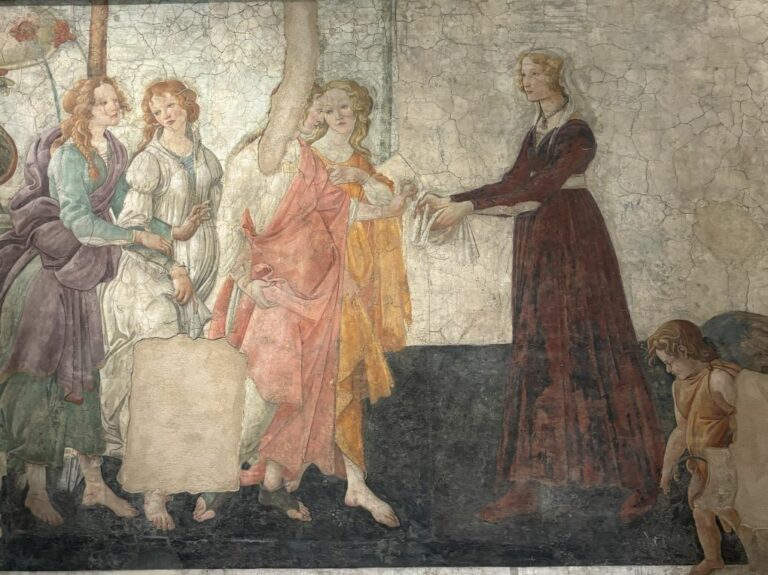
After visiting the Mona Lisa, we encourage you to meet the rest of the Italian masters. Take Sandro Botticelli, for example. Many historians believe that the face that appears again and again in his works was inspired by Simonetta Vespucci, a Florentine noblewoman celebrated for her beauty and said to have captured the artist’s heart. After her untimely death, her delicate features often appear in his paintings, almost as if he was trying to preserve her in paint.
At the Louvre, in works such as Venus and the Three Graces Presenting Gifts to a Young Woman, you can study those refined profiles and flowing lines in relative calm. In the evening light, Botticelli’s women feel even more ethereal, their pale skin and golden hair softly illuminated. There is something quietly romantic about encountering them after dark, when the galleries are silent and you have the time to really look.
The same goes for Baroque artist, Caravaggio. His dramatic contrasts and shadowed figures seem perfectly at home after dark. In a quieter gallery, you can study the tension in his scenes without distraction, noticing details that are often missed during busier hours.
It is in these moments that the Louvre Museum at night truly reveals its charm and the masterpieces stop competing for attention
Sculpture Galleries at the Louvre at Night
Some of our personal favorite places to visit at night are Cour Marly and Cour Puget. Both are located in the Richelieu wing of the museum, on the ground floor and the -1 level. These spaces were once completely open to the sky, functioning almost like interior courtyards. In the 1990s, they were covered with glass skylights to better protect the sculptures, while still preserving that airy, open feeling.
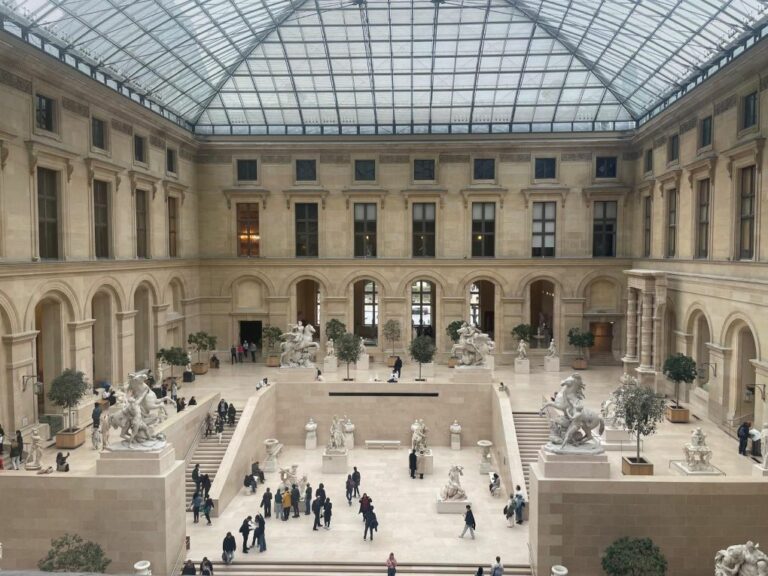
Cour Marly showcases the sculptures that once decorated the gardens and grounds of the Château de Marly, a private estate built by Louis XIV just a few miles from the famous Château de Versailles. Although the château itself no longer stands, the estate remains open to visitors today, and its beautiful park still features several original statues, offering a glimpse into the splendor of this refined royal retreat.
Many of the works on display reflect the Sun King’s personal taste and political symbolism: hunting scenes, mythological heroes, allegorical virtues, gods and nymphs. Our personal favorites are the Marly Horses, rearing with dramatic energy, and the River God sculptures, monumental reclining male figures representing the great rivers of France. At night, the shadows cast across their muscles and flowing drapery give them a striking sense of movement, almost as if they might step down from their pedestals.
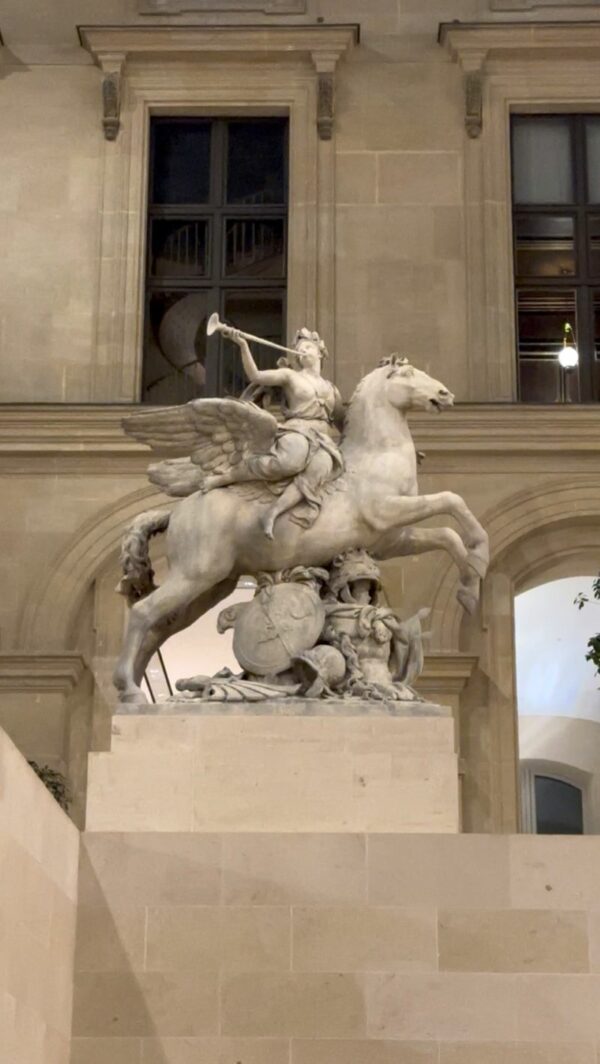
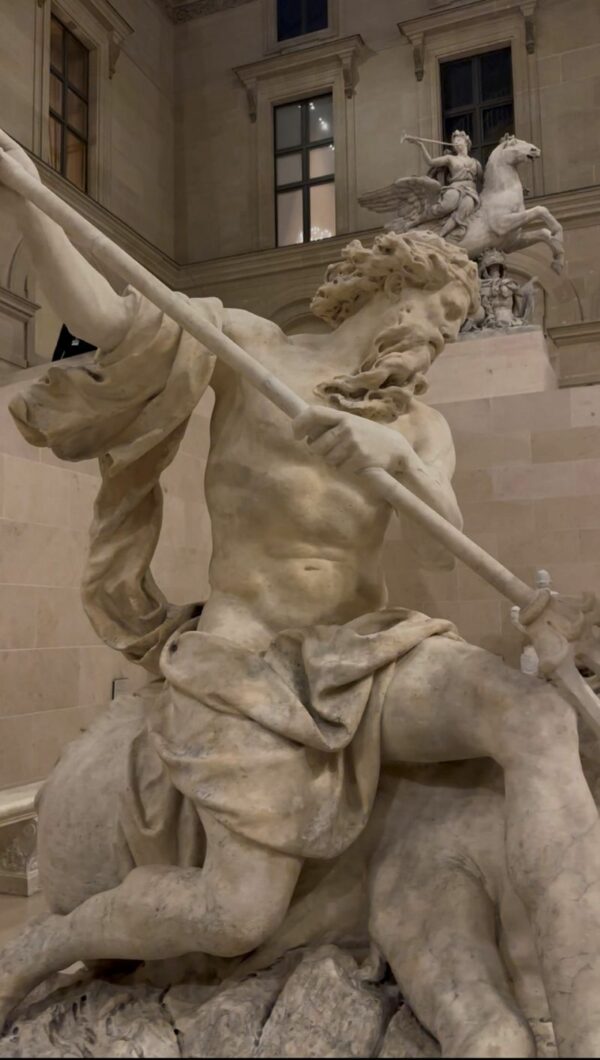
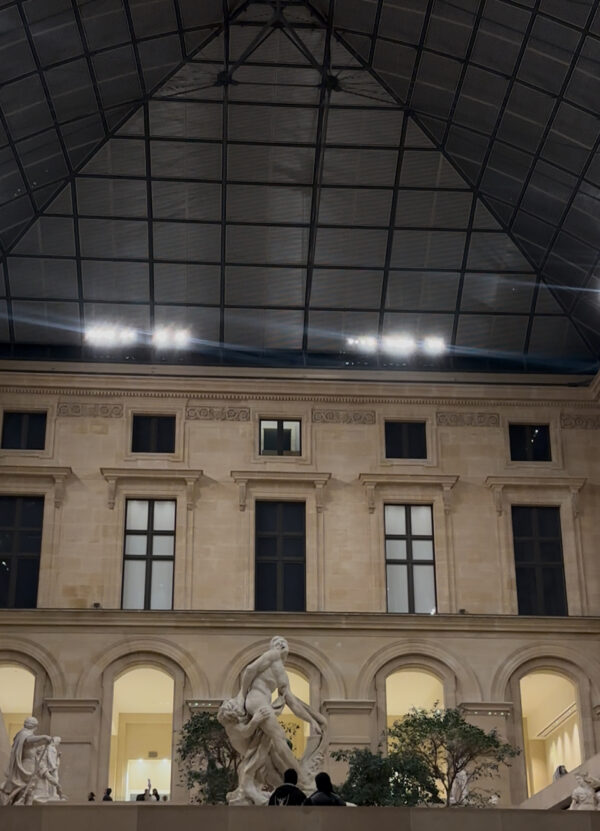
Cour Puget was named after the French baroque artist Pierre Puget and gathers together sculptures originally commissioned for Versailles, other royal estates, and important public monuments. The atmosphere here feels more theatrical. Among the most notable works is Milo of Croton, frozen in the dramatic moment of struggle, his body twisting in tension.
Nearby, you will also encounter Perseus and Andromeda, a sculpture that captures a completely different kind of drama, the suspended instant between danger and rescue, marble transformed into narrative. And then there is Hercules in Repose, powerful yet unexpectedly human, the hero resting after his labors. In the evening calm, these mythological figures feel less like distant legends and more like characters paused mid story, waiting for you to walk around them and discover each angle.
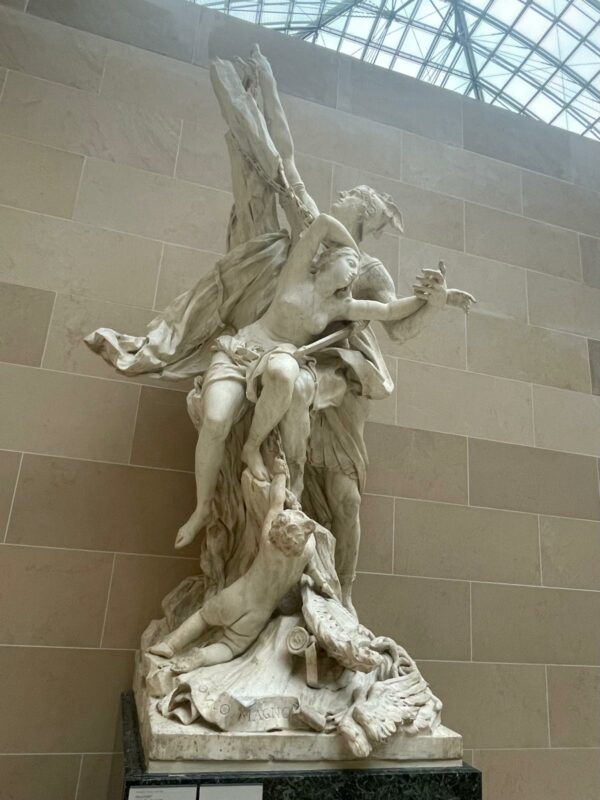
The Louvre’s Ancient Sculptures in the Evening Light
Beyond the Baroque drama of Cour Marly and Cour Puget, the Louvre’s ancient sculpture collections take on an entirely different presence at night. The marble seems cooler, the shadows deeper, and the figures more introspective.
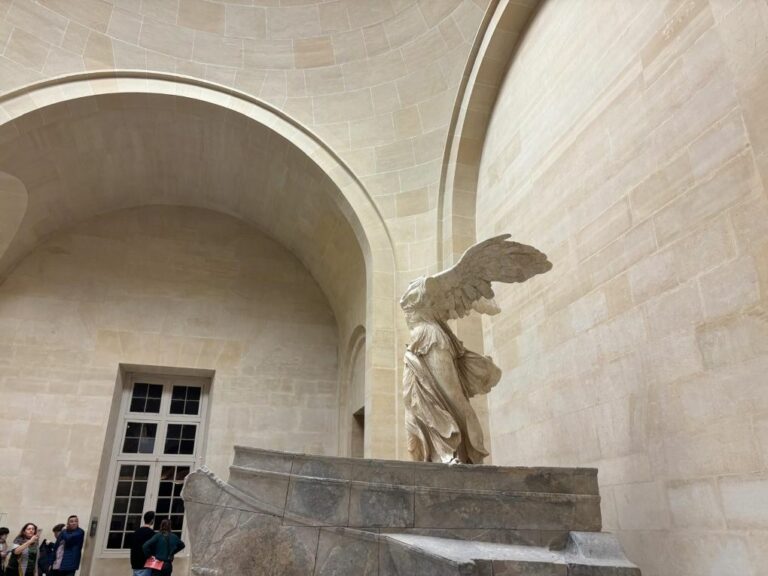
The Winged Victory of Samothrace is perhaps the most powerful example. Positioned at the top of the Daru staircase, she appears almost suspended in motion. In the evening light, with fewer visitors ascending the steps, you can appreciate the sweep of her wings and the way her garments cling to her body as if shaped by sea wind. There is something undeniably cinematic about encountering her after dark, as though she has just landed.
Not far away, the Borghese Gladiator offers a completely different energy. Tensed, alert, caught mid combat, his anatomy is rendered with astonishing precision. In the calmer nighttime atmosphere, you can circle the sculpture slowly, noticing how the muscles shift from every angle, how the entire figure seems balanced on the edge of movement.
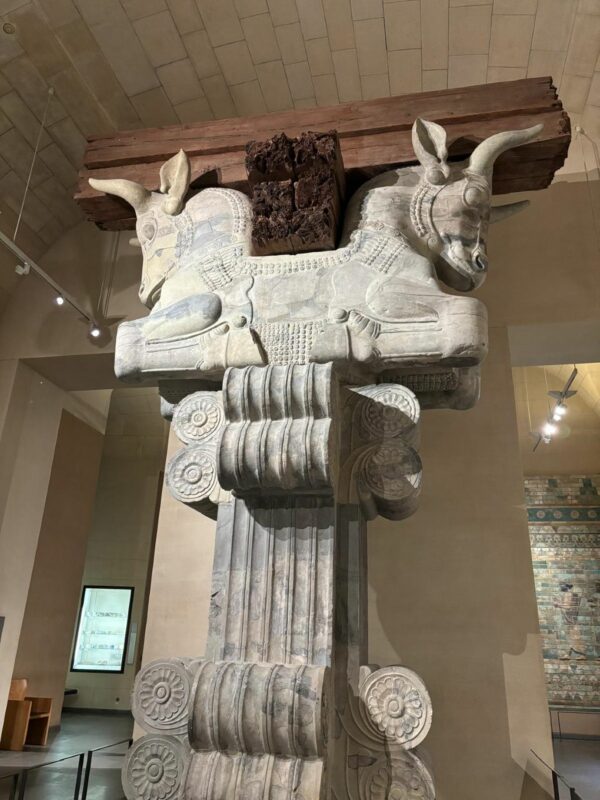
Throughout the Greek and Roman galleries, ancient gods, athletes, and mythological heroes line the halls in quiet procession. Without the daytime crowds, they feel less like artifacts and more like presences. The Louvre Museum at night allows you to move among them at your own pace, absorbing not only their beauty but the weight of the civilizations they represent.
In the quieter evening hours, you can walk around these sculptures slowly, observing them from multiple angles, noticing the details in the marble that are often missed during the day. The scale, the ambition, and the emotion of these works become much more apparent when you are not competing with a crowd.
The Grand Louvre Architecture After Dark
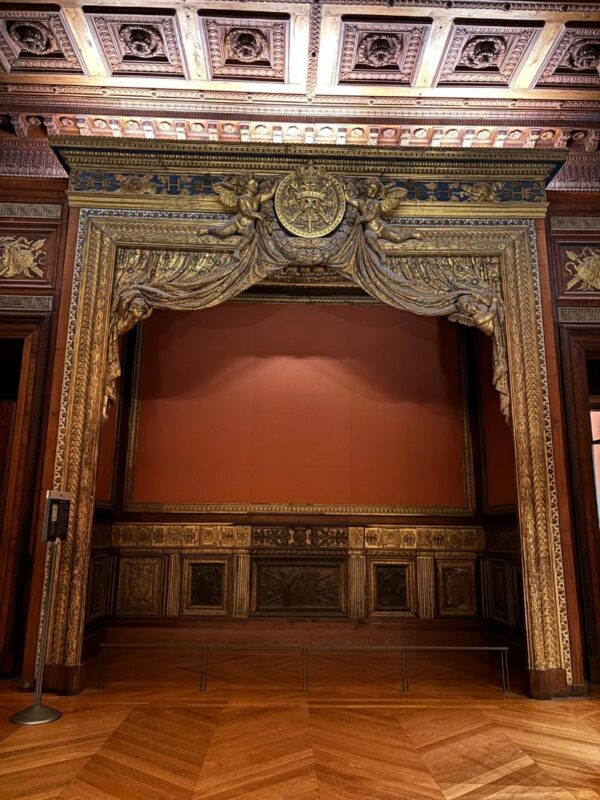
The architectural features of the Louvre also completely changes in the dark. It becomes a much more somber, reflective place the later you go, which is a huge contrast to what you might experience during peak visiting hours. The ceilings in particular begin to demand your attention. During the day, it is easy to forget to look up. At night, with fewer distractions, you start to notice the painted vaults, the ornate moldings, the gilded details that frame entire rooms. Some galleries feel like a cathedral, their soaring ceilings and grand proportions quietly echoing above you.
One of the most striking examples is the Salle des Caryatides. The sculpted female figures that line the room seem to carry the gallery with a quiet strength, their stone silhouettes more dramatic in the evening light. Originally used for royal festivities, the room holds onto that sense of ceremony. When it is nearly empty, you can stand beneath those carved figures and imagine the music, the banquets, the movement that once filled the space.
Just beyond, the Galerie d’Apollon offers another unforgettable moment. This long, radiant gallery, with its richly painted ceiling and gilded ornamentation, was designed as a celebration of royal power and artistic brilliance. The ceiling panels shimmer softly at night, their mythological scenes unfolding overhead in layers of gold and color. It is no coincidence that this gallery later inspired the Hall of Mirrors at Versailles. In the quieter evening atmosphere, you can take your time here, letting your eyes travel slowly from the intricate details above to the glittering crown jewels displayed below. The effect is both intimate and grand, a reminder that the Louvre was once a palace before it was a museum.
And if you step outside toward the Cour Carrée, the transformation continues. The vast square courtyard, enclosed by classical façades, feels monumental at night. The symmetry becomes more pronounced, the stone glowing softly against the dark sky.
When visiting at night, you will find yourself wandering through multiple empty or almost empty galleries (especially in the lesser-visited spaces), able to admire pieces without the crowds or the fear of being bumped into. You hear your own footsteps on the marble floors. You pause in the center of a room and realize just how vast it is. The architecture, the ceilings, and the artworks begin to feel connected, as if the palace itself is part of the exhibition. It is in these quieter moments that the Louvre feels less like a museum and more like a royal residence waiting for its guests to arrive.
The Louvre Museum Night Opening Hours – What You Need to Know
Official Late-Night Louvre Openings Explained
The Louvre has 2 weekly nocturnes, or evenings when it remains open past 5PM.
This takes place on Wednesday and Friday nights, with the museum staying open until 9PM, and last admission at 8PM. That extra time may not sound dramatic on paper, but it makes a real difference in atmosphere. By early evening, the daytime tour groups have thinned out and the pace inside the galleries noticeably softens.
In addition, the first Friday of the month is free for all for nocturnal admission, (although July and August are excluded). Even on those free evenings, we strongly recommend reserving in advance. Free does not mean available, especially in Paris. But if timed well, it can be a wonderful opportunity to experience the Louvre Museum at Night with a more local crowd and a lively yet still manageable energy.
Seasonal Variations and Special Night Events at the Louvre
The Louvre offers several different activities suited for both adults and children during these nighttime openings, including regular guided tours and what they call “unusual visits,” run by the Parcours OFF. These Parcours OFF programs are specifically designed for those aged 18 to 25 and often include improv shows, perfume ateliers, live artistic performances, and even yoga classes held inside the museum. These events are a bit more experimental, a bit more playful, but still grounded by centuries of art and history.
There is also the European Night of Museums, which takes place every year in late May. On this evening, museums across France and Europe, including the Louvre, open their doors to the public completely free of charge. We would still strongly recommend reserving in advance. The atmosphere is lively and unique, with special programming, themed tours, performances, and one night only experiences woven into the visit. It feels less like a standard museum evening and more like a cultural celebration, offering a rare opportunity to experience the Louvre Museum at night in a distinctly festive and communal way.
Transportation - How to Get to the Louvre at Night
Metro:
The Louvre has its own metro station, Palais Royal / Musée du Louvre, serving metro lines 1 and 7.
For the easiest access to the museum, follow the signs toward either door 1, Passage Richelieu, or door 7, Carrousel du Louvre. The Carrousel is often considered one of the “secret entrances” since it brings you into an underground shopping mall rather than directly onto the street. However, the mall can be surprisingly confusing to navigate, and you miss the iconic view of the Louvre Pyramid glowing at night. For that reason, we usually recommend exiting at door 1 over door 7.
Car or taxi:
The smoothest and least stressful way to arrive, as long as you are not the one driving. A driver can drop you within easy walking distance of the main entrances, allowing you to step out and head straight in without worrying about directions. An even better option is arriving with a private guide, so you do not have to think about logistics at all. You simply arrive and begin.
Walking:
Arguably the most romantic way to reach the Louvre. If you are staying nearby, consider strolling over just before your timed entry. Watching the Pyramid illuminate as the sky darkens is part of the experience. You can enter through the main Pyramide entrance or, if you are accompanied by a licensed guide, through the more discreet Passage Richelieu door.
The Louvre Museum Night Opening Hours – What You Need to Know
Night vs Day – Key Differences at a Glance
During the day you have more natural light, but more people. Sunlight filters through the glass pyramid and certain skylights, giving some galleries a softer, more neutral tone. That natural brightness can be beautiful, especially in rooms filled with large scale paintings. But it also comes with movement, noise, and a constant flow of visitors passing in front of you.
Visiting the Louvre at night, you experience the works in more artificial light, but with significantly fewer people. The lighting becomes more focused and intentional, spotlighting canvases and sculptures in a way that feels almost theatrical. Shadows deepen, colors appear richer, and contrasts become more pronounced. Instead of adjusting your position to avoid a crowd, you can adjust your position simply to see better. During the day you observe the art alongside hundreds of others. At night, it can feel as though the art is waiting specifically for you.
Which Option Is Right for You?
Like most of the advice we give, it really depends on how you want to experience the Louvre, and how you want to fit that experience into your visit to France.
If your priority is seeing as much as possible, checking off major masterpieces, and maximizing your hours inside the museum, a daytime visit may make more sense. The longer opening hours give you more flexibility, and if this is your very first time in Paris, there is something undeniably exciting about experiencing the Louvre in its full daytime energy.
However, if you value atmosphere over volume, depth over speed, and emotion over efficiency, the Louvre Museum at night may be the better choice. An evening visit invites you to slow down. You are less likely to rush from one highlight to the next. Instead, you can choose a few key galleries and truly engage with them.
For travelers staying in Paris for several days, we often suggest integrating the night visit into a broader cultural evening. Perhaps you spend the afternoon at leisure, enjoy an early dinner, and then step into the museum as the city begins to quiet. Or you combine it with a concert, a private Seine cruise, or a late reservation nearby. In that context, the Louvre Museum at Night becomes part of a carefully composed Parisian evening rather than a standalone museum stop.
Ultimately, the right option is the one that aligns with how you like to travel. Some of you thrive in the buzz of a lively crowd. Others prefer space, silence, and the feeling of having discovered something slightly off the obvious path. The good news is that the Louvre offers both. The key is deciding which version of the experience you want to remember.
Private Guided Tours at Night
An evening at the Louvre is already special. With the right guide, it becomes extraordinary.
A private licensed guide allows you to move with intention. Instead of wandering or second guessing which wing to prioritize, you follow a carefully curated path tailored to your interests. Perhaps you want to focus on Italian masters and mythological sculpture. Perhaps you are drawn to French Romanticism or royal history. In the calmer nighttime atmosphere, a guide can take full advantage of the quieter galleries, lingering where it makes sense and adjusting the rhythm naturally.
There is also something different about storytelling after dark. The palace feels more intimate, and the narratives of kings, queens, artists, and scandals seem to echo a little more vividly. A private guided visit to the Louvre Museum at night transforms the museum from a vast institution into a personal experience.
VIP & After-Hours Access – Is It Possible?
True full privatization of the Louvre is extremely rare and reserved for exceptional circumstances, often tied to major events or corporate partnerships. However, there are ways to create a more exclusive feeling within the framework of what is possible. Carefully timed entries, strategic routing through quieter wings, and personalized guidance can dramatically change how the evening feels.
However, in certain cases, private events and special arrangements can be organized in collaboration with the museum, depending on availability and scope. If you are interested in learning more about a privatized visit, please contact us!
Why a Chauffeur-Driven Experience Changes Everything
An elegant evening deserves a seamless beginning and end.
Arriving at the Louvre with a dedicated chauffeur removes the small frictions that can interrupt the mood. There is no searching for taxis, no navigating unfamiliar streets, no wondering which entrance is correct. You step out, and the experience begins.
After your visit, your driver is waiting. Perhaps you continue on to dinner. Perhaps you return to your hotel. The transition is effortless. When the logistics disappear, the evening feels fluid and composed, allowing the Louvre Museum at Night to become part of a larger, beautifully orchestrated Parisian experience.
FAQ – Louvre Museum at Night
No. The Louvre offers late night openings on Wednesdays and Fridays, when the museum remains open until 9PM. Outside of these evenings, it closes at its standard time.
Yes, especially if you prefer a calmer and more atmospheric introduction to the museum. While you may see slightly fewer galleries than during a full daytime visit, the experience often feels more memorable and intimate.
Absolutely. Private licensed guides are available during official evening openings and can tailor the visit to your interests, making the most of the quieter galleries.
We recommend planning for 2 to 3 hours. This allows enough time to focus on key masterpieces and a few carefully chosen galleries without feeling rushed.
Enhance Your Parisian Getaway With Exclusive Private Tours
To elevate your evening Louvre visit, consider an exclusive private Louvre Through the Ages tour! At Paris to Versailles Private Tours, our licensed guides and dedicated chauffeurs lead you through tailor‑made experiences steeped in French heritage, refinement, and luxury.
Louvre Private Tour
Learn more about the fascinating history and lavish royal lives with your expert guide!